I have been unable to post a new blog in the past couple of months due to various commitments. Nonetheless, I discovered eight wonderful commentaries that I had written back in 2008 and posted on the “Syndicated News” web site. They were penned during a sizzling summer, shortly after the price of crude oil hit a record high of $147.27 in July 2008 and during a black fall, when in a single week the Dow Jones Industrial Average plummeted 1,874 points, or 18%, in its worst weekly decline ever on both a point and percentage basis.
Some of these essays on our fragile political, economic and foreign policy landscape at that time, now seem quite prescient, if I might say so myself. I wish mainstream pundits would review their writings from a couple of years ago to see if they had the requisite foresight on some of the pressing issues of the day. As the saying goes, hindsight is 20/20, but it’s foresight that really qualifies you as a pundit. So here are the links to my syndicated efforts from that turbulent period in 2008:
In the War on Terrorism: A Passage Through India (8/14/2008)
Can a new, expanded NATO avert Cold War II? (8/21/2008)
Obama-Biden his time, as McCain-Palin to irrelevance! (9/3/2008)
Victory in Iraq (9/8/2008)
The Great Regression (9/30/2008)
For U.S. Foreign Policy: A "New Clear" Passage Through India (10/20/2008)
The Political Pendulum: Swinging To Liberalism (10/27/2008)
Too Much, Too Little, Too Late From The Fed: We Are All Keynesians Now! (10/30/2008)
So do I qualify as a pundit?
Showing posts with label Wall Street Journal. Show all posts
Showing posts with label Wall Street Journal. Show all posts
Friday, May 21, 2010


Tuesday, March 23, 2010
Life, Liberty and the pursuit of “Universal Healthcare”
It was barely a week ago that the Wall Street Journal published my letter, “Stock Markets Reflect Nation's Monetary And Fiscal Policies,” in which I had posited that
A few days later on Sunday night, I was watching the House debate ObamaCare and I could literally see history repeating itself. The last time Republicans voted lock, stock and barrel against a signature Democratic initiative by a near identical margin was the Clinton Administration’s Omnibus Budget Reconciliation Act of 1993. Back then, the GOP had predicted similar dire consequences of a deep recession, significant job losses and horrendous deficits – by the time the 1990s ended, we had actually achieved diametrically opposite results!
Nonetheless, it was with trepidation that I waited for the markets to react on Monday to the reality of ObamaCare. The Dow Jones Industrial Average (DJIA) had closed at 10735 on Friday evening and when it dipped 40 points at Monday’s opening bell, my heart sank. But that initial dip was more related to overnight trends in overseas markets according to most analysts. By the end of the day on Monday, the DJIA eventually closed up 50 points at 10785. On Tuesday, President Obama signed ObamaCare, officially known as the Patient Protection and Affordable Care Act, into law. Lo and behold, the DJIA went up another 100 odd points and closed at 10889. In fact, all three major stock market indices –S&P 500, Nasdaq composite, and DJIA–are now at 18 to 19 month highs!
So after nearly a century of trying, Democrats finally made a new, bold declaration of independence that we are indeed endowed with certain unalienable rights, that among these are Life, Liberty and the pursuit of “Universal Healthcare.” At the end of the day, the American people are going to realize that Democratic presidents have always delivered on the seminal issues of our times including Social Security, Civil Rights, Voting Rights, Medicare and now Healthcare Reform.
As President Obama gets ready to hit the road to enlighten the American people on the immediate benefits that will flow from ObamaCare, it is imperative that he links the economics of healthcare to the future health of our economy. Also, he can make a simple case to his skeptics – wider coverage, healthier people, more economic output, and hence more jobs. It’s a “trickle down” argument that even conservatives will appreciate.
Finally on a lighter note, the passage of ObamaCare comes with fringe benefits such as self-imposed exile to Costa Rica for some prominent naysayers, the repudiation of tea over coffee as the quintessential American beverage, and hopefully the defeat of fear-mongering as a political tactic by deep-pocketed interests groups! Republicans might want to think twice about running on a repeal platform because a brand new USA Today/Gallup poll out today shows that Americans by a 49%-40% margin already favor ObamaCare as “a good thing.” Once the people get used to a good thing, they are not likely to give it up and candidates promising to take it away could face voter backlash – to be forewarned is to be forearmed! Let the healing begin!
“if the Dow has gained 62% since its March 9, 2009, low, I would expect that the markets have done this after digesting the realities of President Obama's $787 billion stimulus package, his pending $1 trillion health-care bill, his projected $1.6 trillion budget deficit for fiscal 2010, and the end of the Bush tax cuts in 2011, etc.”
A few days later on Sunday night, I was watching the House debate ObamaCare and I could literally see history repeating itself. The last time Republicans voted lock, stock and barrel against a signature Democratic initiative by a near identical margin was the Clinton Administration’s Omnibus Budget Reconciliation Act of 1993. Back then, the GOP had predicted similar dire consequences of a deep recession, significant job losses and horrendous deficits – by the time the 1990s ended, we had actually achieved diametrically opposite results!
Nonetheless, it was with trepidation that I waited for the markets to react on Monday to the reality of ObamaCare. The Dow Jones Industrial Average (DJIA) had closed at 10735 on Friday evening and when it dipped 40 points at Monday’s opening bell, my heart sank. But that initial dip was more related to overnight trends in overseas markets according to most analysts. By the end of the day on Monday, the DJIA eventually closed up 50 points at 10785. On Tuesday, President Obama signed ObamaCare, officially known as the Patient Protection and Affordable Care Act, into law. Lo and behold, the DJIA went up another 100 odd points and closed at 10889. In fact, all three major stock market indices –S&P 500, Nasdaq composite, and DJIA–are now at 18 to 19 month highs!
So after nearly a century of trying, Democrats finally made a new, bold declaration of independence that we are indeed endowed with certain unalienable rights, that among these are Life, Liberty and the pursuit of “Universal Healthcare.” At the end of the day, the American people are going to realize that Democratic presidents have always delivered on the seminal issues of our times including Social Security, Civil Rights, Voting Rights, Medicare and now Healthcare Reform.
As President Obama gets ready to hit the road to enlighten the American people on the immediate benefits that will flow from ObamaCare, it is imperative that he links the economics of healthcare to the future health of our economy. Also, he can make a simple case to his skeptics – wider coverage, healthier people, more economic output, and hence more jobs. It’s a “trickle down” argument that even conservatives will appreciate.
Finally on a lighter note, the passage of ObamaCare comes with fringe benefits such as self-imposed exile to Costa Rica for some prominent naysayers, the repudiation of tea over coffee as the quintessential American beverage, and hopefully the defeat of fear-mongering as a political tactic by deep-pocketed interests groups! Republicans might want to think twice about running on a repeal platform because a brand new USA Today/Gallup poll out today shows that Americans by a 49%-40% margin already favor ObamaCare as “a good thing.” Once the people get used to a good thing, they are not likely to give it up and candidates promising to take it away could face voter backlash – to be forewarned is to be forearmed! Let the healing begin!
Thursday, March 18, 2010
Mossad on the Move
There has been much brouhaha in the media of late about an Israel vs. United States sparring contest. Following Vice President Biden’s recent contentious visit to Israel, Thomas L. Friedman of the New York Times went apoplectic in his March 14th column, “Driving Drunk in Jerusalem.” He accused Israel of making it “look like America’s most dependent ally can push” us around. Then Robert Kagan got into the act with a contrarian viewpoint that not only empathized with Israel but also was more scathing in his judgment of President Obama’s overall foreign policy. In his March 17th column in the Washington Post, “Allies everywhere feeling snubbed by President Obama,” Mr. Kagan suggested that “Israelis shouldn't feel that they have been singled out.”
On the same day, John Bolton, a senior fellow at the American Enterprise Institute, spouted his usual hawkish tone in the Wall Street Journal. In “Israel and The Crisis With Obama,” Mr. Bolton pointed out that “Israel has sought to accommodate Mr. Obama on two critical issues: negotiations with Palestinians and Iranian nuclear weapons.” After glossing over the distraction of the Israeli settlements, Mr. Bolton reiterated his long-held position that “Americans must realize that allowing Iran to obtain nuclear weapons is empowering an existential threat to the Israeli state, to Arab governments in the region that are friendly to the U.S., and to long-term global peace and security.”
I suspect that a lot of Americans already recognize that a nuclear-armed Iran is a serious threat to world peace given some of the vile pronouncements of its holocaust-denying leaders. So let me expand on a conspiracy theory that I believe is playing out right now in the Middle East. First, it is almost impossible to believe that Israeli Prime Minister Netanyahu was blindsided by his own Interior ministry during Vice President Biden’s recent visit. Second, the Israelis are too smart to expect anyone to believe as much. Thus, per their master plan, Israel’s Mossad began by intentionally blindsiding the British government with their infamous Dubai operation in January – assassinating a prominent Hamas leader using British identities – and is now making it appear like they can push the United States around as well.
This “modern-day David taking on two western Goliaths back-to-back" is a staged precursor to an imminent Israeli action aimed at taking out relevant Iranian nuclear facilities – without giving Iran any reason to suspect any involvement of the traditional Anglo-American alliance. If the Israeli airstrikes are successful, they will simultaneously achieve both of Mr. Bolton’s stated objectives and additionally contribute to a more favorable outcome in Iraq. It seems to me that Mossad is on the move – setting the stage for what Mr. Bolton has been propagating for a long time, which is “a pre-emptive strike against Iran's nuclear program.” Israel recognizes that such action is the only way to achieve a lasting Middle East peace because it will:
1. Neutralize the Iranian threat and its ascendancy much to the satisfaction of the Arab nations and leadership in the Middle East.
2. Force the Palestinian leadership to jettison “proximity talks” in favor of “direct talks” with them towards a permanent peace settlement.
3. Ensure that Iran will no longer influence the formation of a pro-Iranian government in Iraq following recently concluded parliamentary elections there.
Americans can only hope that Israel gets it right this time just as it did with its pre-emptive strike on Iraq’s Osirak nuclear facility back in 1981. Two decades later, we were unable to find WMD in Iraq in large part due to that prescient action. If the United Nations cannot convince Iran to abandon its pursuit of WMD, maybe the mighty arm of the Mossad will?
On the same day, John Bolton, a senior fellow at the American Enterprise Institute, spouted his usual hawkish tone in the Wall Street Journal. In “Israel and The Crisis With Obama,” Mr. Bolton pointed out that “Israel has sought to accommodate Mr. Obama on two critical issues: negotiations with Palestinians and Iranian nuclear weapons.” After glossing over the distraction of the Israeli settlements, Mr. Bolton reiterated his long-held position that “Americans must realize that allowing Iran to obtain nuclear weapons is empowering an existential threat to the Israeli state, to Arab governments in the region that are friendly to the U.S., and to long-term global peace and security.”
I suspect that a lot of Americans already recognize that a nuclear-armed Iran is a serious threat to world peace given some of the vile pronouncements of its holocaust-denying leaders. So let me expand on a conspiracy theory that I believe is playing out right now in the Middle East. First, it is almost impossible to believe that Israeli Prime Minister Netanyahu was blindsided by his own Interior ministry during Vice President Biden’s recent visit. Second, the Israelis are too smart to expect anyone to believe as much. Thus, per their master plan, Israel’s Mossad began by intentionally blindsiding the British government with their infamous Dubai operation in January – assassinating a prominent Hamas leader using British identities – and is now making it appear like they can push the United States around as well.
This “modern-day David taking on two western Goliaths back-to-back" is a staged precursor to an imminent Israeli action aimed at taking out relevant Iranian nuclear facilities – without giving Iran any reason to suspect any involvement of the traditional Anglo-American alliance. If the Israeli airstrikes are successful, they will simultaneously achieve both of Mr. Bolton’s stated objectives and additionally contribute to a more favorable outcome in Iraq. It seems to me that Mossad is on the move – setting the stage for what Mr. Bolton has been propagating for a long time, which is “a pre-emptive strike against Iran's nuclear program.” Israel recognizes that such action is the only way to achieve a lasting Middle East peace because it will:
1. Neutralize the Iranian threat and its ascendancy much to the satisfaction of the Arab nations and leadership in the Middle East.
2. Force the Palestinian leadership to jettison “proximity talks” in favor of “direct talks” with them towards a permanent peace settlement.
3. Ensure that Iran will no longer influence the formation of a pro-Iranian government in Iraq following recently concluded parliamentary elections there.
Americans can only hope that Israel gets it right this time just as it did with its pre-emptive strike on Iraq’s Osirak nuclear facility back in 1981. Two decades later, we were unable to find WMD in Iraq in large part due to that prescient action. If the United Nations cannot convince Iran to abandon its pursuit of WMD, maybe the mighty arm of the Mossad will?
Tuesday, March 09, 2010
Yoo Must Be Kidding... but Toensing is not!
John Yoo, who is a law professor at the University of California, Berkeley and a visiting scholar at the American Enterprise Institute, was a Justice Department official from 2001-03 during the tumultuous post-9/11 years. Mr. Yoo became famous for co-authoring legal memos that saw the evolution of “enhanced interrogations techniques.”
In the February 24th edition of the Wall Street Journal, Mr. Yoo penned a rather pompous commentary, "My Gift to President Obama.” While Mr. Yoo might possess a great legal mind, it is definitely not suffused with humility. Despite being put off by his opening salvo, “Barack Obama may not realize it, but I may have just helped save his presidency,” I still read through his entire hubristic essay.
Most of his diatribe was dedicated to problems with the Justice Department's Office of Professional Responsibility (OPR), who ran an extended investigation into the CIA's detention and interrogation methods that had evolved from Mr. Yoo’s afore-mentioned legal opinions. In his lengthy invective, Mr. Yoo failed to address President Obama’s basic proposition, which rejects “as false the choice between our safety and our ideals,” and which Mr. Yoo even acknowledged upfront in his article.
Subsequently, Victoria Toensing, a deputy assistant attorney general in the Reagan administration (1984-88) and chief counsel for the Senate Intelligence Committee (1981-84), got into the act. In the March 2nd edition of the Wall Street Journal, Ms. Toensing followed up Mr. Yoo’s generous bestowal on President Obama with her take on the subject in "KSM Deserves Military Justice” – even contradicting President Reagan on this issue!
She began by acknowledging that “In the 1980s, the Reagan administration established a policy for trying terrorists in civilian courts.” And then added “I know the basis for its policy of trying terrorists in federal courts—and why it is no longer applicable.” She then went on to provide a lengthy historical but unconvincing argument – citing the case of Mohammed Ali Hamadi, one of the terrorists involved in the June 1985 hijacking of TWA Flight 847, which resulted in the murder of U.S. Navy diver Robert Stethem. Mr. Hamadi was tried, convicted, jailed and released after a lengthy term by the German court system.
By comparison, her other citation “so-called 20th 9/11 hijacker Zacarious Moussaoui,” was tried by the U.S. criminal justice system and sentenced to six life terms without the chance of parole – a sentence he is now serving in a Supermax prison in Colorado. Nevertheless, Ms. Toensing concluded her article by saying, “We now have a system that provides due process while recognizing there are differences between enemy combatants and bank robbers. We should use it.” One wonders if Zacarious Moussaoui feels like a petty “bank robber” following his lifetime incarceration by the U.S. criminal justice system.
My point is that we are ill-served by ideologues on both sides of this debate, who insist on this false dichotomy between the abilities of our criminal justice system and what Mr. Yoo called “the president’s constitutional ability to fight the enemies that threaten our nation today.” Neither approach in and of its own is sacrosanct and sufficient – executing and winning this war on terrorism will require a judicious application of both, constitutionally granted executive power and the use of our world-famous legal system.
To conclude in the tenor of the Yoo-Toensing debate… So Let It Be Written, So Let It Be Done!
In the February 24th edition of the Wall Street Journal, Mr. Yoo penned a rather pompous commentary, "My Gift to President Obama.” While Mr. Yoo might possess a great legal mind, it is definitely not suffused with humility. Despite being put off by his opening salvo, “Barack Obama may not realize it, but I may have just helped save his presidency,” I still read through his entire hubristic essay.
Most of his diatribe was dedicated to problems with the Justice Department's Office of Professional Responsibility (OPR), who ran an extended investigation into the CIA's detention and interrogation methods that had evolved from Mr. Yoo’s afore-mentioned legal opinions. In his lengthy invective, Mr. Yoo failed to address President Obama’s basic proposition, which rejects “as false the choice between our safety and our ideals,” and which Mr. Yoo even acknowledged upfront in his article.
Subsequently, Victoria Toensing, a deputy assistant attorney general in the Reagan administration (1984-88) and chief counsel for the Senate Intelligence Committee (1981-84), got into the act. In the March 2nd edition of the Wall Street Journal, Ms. Toensing followed up Mr. Yoo’s generous bestowal on President Obama with her take on the subject in "KSM Deserves Military Justice” – even contradicting President Reagan on this issue!
She began by acknowledging that “In the 1980s, the Reagan administration established a policy for trying terrorists in civilian courts.” And then added “I know the basis for its policy of trying terrorists in federal courts—and why it is no longer applicable.” She then went on to provide a lengthy historical but unconvincing argument – citing the case of Mohammed Ali Hamadi, one of the terrorists involved in the June 1985 hijacking of TWA Flight 847, which resulted in the murder of U.S. Navy diver Robert Stethem. Mr. Hamadi was tried, convicted, jailed and released after a lengthy term by the German court system.
By comparison, her other citation “so-called 20th 9/11 hijacker Zacarious Moussaoui,” was tried by the U.S. criminal justice system and sentenced to six life terms without the chance of parole – a sentence he is now serving in a Supermax prison in Colorado. Nevertheless, Ms. Toensing concluded her article by saying, “We now have a system that provides due process while recognizing there are differences between enemy combatants and bank robbers. We should use it.” One wonders if Zacarious Moussaoui feels like a petty “bank robber” following his lifetime incarceration by the U.S. criminal justice system.
My point is that we are ill-served by ideologues on both sides of this debate, who insist on this false dichotomy between the abilities of our criminal justice system and what Mr. Yoo called “the president’s constitutional ability to fight the enemies that threaten our nation today.” Neither approach in and of its own is sacrosanct and sufficient – executing and winning this war on terrorism will require a judicious application of both, constitutionally granted executive power and the use of our world-famous legal system.
To conclude in the tenor of the Yoo-Toensing debate… So Let It Be Written, So Let It Be Done!
Tuesday, March 02, 2010
Google Me Once, Shame on You; Google Me Twice or More and Make the Google God Happy…
With apologies to President George W. Bush, I mangle that old adage even more to make a point. In this era of Search Engine Optimization and Social Media, it is becoming imperative for the LinkedIn individual to also show up on Facebook and Twitter as required ̶ for me it’s more about trying to control my online exposure (i.e., my digital footprint) than mere socializing (or as we still call it in the business world ̶ networking ̶ but that’s a topic for another day).
Nonetheless, to have any effective say on my digital footprint online, I would have to battle the Google God, which I know I cannot. Sidebar: How about I coin a new pet name for the Google God right now – the GooGod (one pronounces the name so that it almost sounds like “Good God” with the middle D silent!)
Now, back to my feeble attempt to appease the GooGod ̶ in the laundry list below, I am linking to the media that have published me in the past several years. Folks, feel free to click away on the links below and help the good stuff rise in the SERPs ̶ go ahead and Google me twice or more, so that the GooGod makes me look nice for sure! If that doesn’t work, I’ll go back to what good old Popeye used to say, “I yam what I yam” and live with it.
Jack Nargundkar in the New York Times on February 20, 2010, "An Apology, for What It’s Worth”
Jack Nargundkar in the International Herald Tribune on February 7, 2010, "A Shift for U.S. Foreign Policy”
Jack Nargundkar in the Wall Street Journal on January 22, 2010, "Lessons to Learn From Scott Brown's 'Tea Party'"
Jack Nargundkar in the Washington Post on December 31, 2009, "Navigating the nation's course after Flight 253"
Jack Nargundkar in the Wall Street Journal on November 21, 2009, "A Compromise on Muslim Freedom"
Jack Nargundkar in the New York Times on October 10, 2009, "Barack Obama, Nobel Peace Laureate”
Jack Nargundkar in the Washington Post on August 26, 2009, "A Changing Tide on the Wars"
Jack Nargundkar in the Business Week on May 1, 2009, “Securing Government Contracts”
Jack Nargundkar in Digital Signage Today on January 21, 2009, “Broadband creates digital signage opportunities in the SMB market”
Jack Nargundkar in the New York Times on January 20, 2009, "President Obama: A Day of Uplift”
Jack Nargundkar in the Wall Street Journal on September 27, 2008, "Is Marking to Market the Problem or Part of Solution?"
Jack Nargundkar in the New York Times on August 24, 2008, "Russia, Georgia and the West”
Jack Nargundkar in the New York Times on April 14, 2008, "Do Asians Really Want a Red-State America?"
Jack Nargundkar in Digital Signage Today on March 24, 2008, “Digital signage strategies for small-to-medium businesses”
Jack Nargundkar in the Washington Post on November 6, 2007, "If Sen. Clinton Were President Clinton"
Jack Nargundkar in the Wall Street Journal on October 15, 2007, "Elections in Pakistan Don't Equal Democracy"
Jack Nargundkar in the New York Times on October 3, 2007, "Anita Hill vs. Clarence Thomas, Redux"
Jack Nargundkar in the New York Times on July 27, 2007, "What Do We Leave Behind in Iraq?"
Jack Nargundkar in the New York Times on June 22, 2007, "Vetoing Stem Cells, Vetoing Life"
Jack Nargundkar in the New York Times on March 8, 2007, "A Verdict for Libby, a Cloud for the White House"
Jack Nargundkar in the New York Times on November 3, 2006, "A Man, a Cab, a Cellphone, a Laptop"
Jack Nargundkar in the Wall Street Journal on October 24, 2006, "Counting War Dead Is Difficult -- Therefore, Let's Not Exaggerate"
Jack Nargundkar in the Wall Street Journal on October 6, 2006, "Musharraf May Be Our Fair-Haired Boy Now . . . But Watch Out"
Jack Nargundkar in the New York Times on September 4, 2006, "Are We Seeing a Half-Empty Glass?"
Jack Nargundkar in the Washington Post on July 29, 2006, "Still Dreaming"
Jack Nargundkar in the New York Times on March 8, 2006, "Bush and the Nuclear Subcontinent"
Jack Nargundkar in the New York Times on January 8, 2006, "Other Voices: How The Times Handled the Surveillance Story"
Jack Nargundkar in the Washington Post on April 11, 2005, "No Individual Blamed"
Jack Nargundkar in the New York Times on April 1, 2005, "A Life Ends, and a Nation Pauses to Reflect"
Jack Nargundkar in the New York Times on December 16, 2004, "Medals at Odds With Reality of War"
Jack Nargundkar in the Washington Post on May 27, 2004, "Punctuate a Comma Date"
Jack Nargundkar in the Washington Post on February 4, 2004, "Screening Bush: The Winners"
Jack Nargundkar in the Wall Street Journal on January 27, 2004, "Hey, Big Spender, Spend a Little Less"
Jack Nargundkar in the Business Week on December 29, 2003, "The Challenge From India"
Jack Nargundkar in the Washington Post on December 5, 2003, "'Cut and Run' and the Right Approach in Iraq"
Jack Nargundkar in the Wall Street Journal on May 2, 2003, "Don't Let Conservatives Define Liberals' Views"
Jack Nargundkar in the Washington Post on April 12, 2003, "Next Steps on Iraq"
Jack Nargundkar in the Wall Street Journal on January 8, 1998, "Behind ’90s Success Is Fiscal Discipline"
Jack Nargundkar in the Business Week on March 17, 1997," WEBCASTING: A FEW TANGLES"
Jack Nargundkar in the Business Week on October 25, 1993," THOUGHTS FOR CHAIRMAN GERSTNER"
Jack Nargundkar in the Wall Street Journal on August 12, 1993, "Dear Laura Tyson…"
Jack Nargundkar in the Wall Street Journal on October 19, 1992, "Reap the Silicon Whirlwind"
Jack Nargundkar in the Business Week on July 13, 1992," SELL THE GREEN CARD TO THE AVERAGE JOE"
Nonetheless, to have any effective say on my digital footprint online, I would have to battle the Google God, which I know I cannot. Sidebar: How about I coin a new pet name for the Google God right now – the GooGod (one pronounces the name so that it almost sounds like “Good God” with the middle D silent!)
Now, back to my feeble attempt to appease the GooGod ̶ in the laundry list below, I am linking to the media that have published me in the past several years. Folks, feel free to click away on the links below and help the good stuff rise in the SERPs ̶ go ahead and Google me twice or more, so that the GooGod makes me look nice for sure! If that doesn’t work, I’ll go back to what good old Popeye used to say, “I yam what I yam” and live with it.
Jack Nargundkar in the New York Times on February 20, 2010, "An Apology, for What It’s Worth”
Jack Nargundkar in the International Herald Tribune on February 7, 2010, "A Shift for U.S. Foreign Policy”
Jack Nargundkar in the Wall Street Journal on January 22, 2010, "Lessons to Learn From Scott Brown's 'Tea Party'"
Jack Nargundkar in the Washington Post on December 31, 2009, "Navigating the nation's course after Flight 253"
Jack Nargundkar in the Wall Street Journal on November 21, 2009, "A Compromise on Muslim Freedom"
Jack Nargundkar in the New York Times on October 10, 2009, "Barack Obama, Nobel Peace Laureate”
Jack Nargundkar in the Washington Post on August 26, 2009, "A Changing Tide on the Wars"
Jack Nargundkar in the Business Week on May 1, 2009, “Securing Government Contracts”
Jack Nargundkar in Digital Signage Today on January 21, 2009, “Broadband creates digital signage opportunities in the SMB market”
Jack Nargundkar in the New York Times on January 20, 2009, "President Obama: A Day of Uplift”
Jack Nargundkar in the Wall Street Journal on September 27, 2008, "Is Marking to Market the Problem or Part of Solution?"
Jack Nargundkar in the New York Times on August 24, 2008, "Russia, Georgia and the West”
Jack Nargundkar in the New York Times on April 14, 2008, "Do Asians Really Want a Red-State America?"
Jack Nargundkar in Digital Signage Today on March 24, 2008, “Digital signage strategies for small-to-medium businesses”
Jack Nargundkar in the Washington Post on November 6, 2007, "If Sen. Clinton Were President Clinton"
Jack Nargundkar in the Wall Street Journal on October 15, 2007, "Elections in Pakistan Don't Equal Democracy"
Jack Nargundkar in the New York Times on October 3, 2007, "Anita Hill vs. Clarence Thomas, Redux"
Jack Nargundkar in the New York Times on July 27, 2007, "What Do We Leave Behind in Iraq?"
Jack Nargundkar in the New York Times on June 22, 2007, "Vetoing Stem Cells, Vetoing Life"
Jack Nargundkar in the New York Times on March 8, 2007, "A Verdict for Libby, a Cloud for the White House"
Jack Nargundkar in the New York Times on November 3, 2006, "A Man, a Cab, a Cellphone, a Laptop"
Jack Nargundkar in the Wall Street Journal on October 24, 2006, "Counting War Dead Is Difficult -- Therefore, Let's Not Exaggerate"
Jack Nargundkar in the Wall Street Journal on October 6, 2006, "Musharraf May Be Our Fair-Haired Boy Now . . . But Watch Out"
Jack Nargundkar in the New York Times on September 4, 2006, "Are We Seeing a Half-Empty Glass?"
Jack Nargundkar in the Washington Post on July 29, 2006, "Still Dreaming"
Jack Nargundkar in the New York Times on March 8, 2006, "Bush and the Nuclear Subcontinent"
Jack Nargundkar in the New York Times on January 8, 2006, "Other Voices: How The Times Handled the Surveillance Story"
Jack Nargundkar in the Washington Post on April 11, 2005, "No Individual Blamed"
Jack Nargundkar in the New York Times on April 1, 2005, "A Life Ends, and a Nation Pauses to Reflect"
Jack Nargundkar in the New York Times on December 16, 2004, "Medals at Odds With Reality of War"
Jack Nargundkar in the Washington Post on May 27, 2004, "Punctuate a Comma Date"
Jack Nargundkar in the Washington Post on February 4, 2004, "Screening Bush: The Winners"
Jack Nargundkar in the Wall Street Journal on January 27, 2004, "Hey, Big Spender, Spend a Little Less"
Jack Nargundkar in the Business Week on December 29, 2003, "The Challenge From India"
Jack Nargundkar in the Washington Post on December 5, 2003, "'Cut and Run' and the Right Approach in Iraq"
Jack Nargundkar in the Wall Street Journal on May 2, 2003, "Don't Let Conservatives Define Liberals' Views"
Jack Nargundkar in the Washington Post on April 12, 2003, "Next Steps on Iraq"
Jack Nargundkar in the Wall Street Journal on January 8, 1998, "Behind ’90s Success Is Fiscal Discipline"
Jack Nargundkar in the Business Week on March 17, 1997," WEBCASTING: A FEW TANGLES"
Jack Nargundkar in the Business Week on October 25, 1993," THOUGHTS FOR CHAIRMAN GERSTNER"
Jack Nargundkar in the Wall Street Journal on August 12, 1993, "Dear Laura Tyson…"
Jack Nargundkar in the Wall Street Journal on October 19, 1992, "Reap the Silicon Whirlwind"
Jack Nargundkar in the Business Week on July 13, 1992," SELL THE GREEN CARD TO THE AVERAGE JOE"
Thursday, September 11, 2008
The Real McCoy
The Internet has become the great equalizer, in that; it has empowered so many people in so many professions in so many ways. Google has given new meaning to the saying, “You can run, but you can’t hide.” YouTube has redefined what we mean by “A picture is worth a thousand words.” Bloggers have neutralized the news cycle by publishing “All the News That's Fit to Print” on a 24/7 basis.
And yet, there is not a Google search item, not one YouTube video, and nary a blog post that brings out the real Senator McCain. So I have decided to publish this satirical take on my alleged tête-à-tête with the Senator. Here’s how I think my faux conversation would expose the real McCoy:
Jack: Senator, let’s cut to the chase… have you heard of the saying “The more things change, the more they remain the same?”
McCain: Yes, but are you trying to suggest something…
Jack: Nothing. How long have you been in Washington?
McCain: I have been in Congress since 1983… I began as a foot-soldier in the Reagan Revolution…
Jack: Yeah, it’s quite amazing how you went from being a well-decorated, retired Navy captain to start out all over again as an ordinary foot-soldier in Congress.
McCain: I have paid my dues, my friend.
Jack: O.K., but many presidential candidates have promised to change Washington in the past 25 years, so how are you any different?
McCain: The others let Washington change ’em. Washington won’t change me. I am the same guy I was 25 years ago. I am set in my ways.
Jack: So you haven’t changed, but you will change Washington?
McCain: Damn straight!
Jack: How do you propose to do that?
McCain: I will veto every earmark that comes across my desk.
Jack: You realize that you will be likely working with a strong Democratic majority in both branches of Congress?
McCain: Yes, but I am determined to approve only pork-free bills.
Jack: Wow! Are you trying to appease the Muslims…
McCain: Very funny, Jack! Everyone’s a comedian…
Jack: But seriously, the last president to veto too many bills lasted only one term – your predecessor’s father – remember, “Read my lips…”
McCain: Of course, but he lost because he raised taxes, not because he vetoed bills!
Jack: Clinton raised taxes and vetoed bills – and still served two terms that saw unprecedented peace and prosperity?
McCain: That is because Clinton had a Republican Congress…
Jack: Reagan worked with a largely Democratic Congress…
McCain: Yeah, but they gave him what he wanted…
Jack: I would imagine that the GOP Congress gave Clinton what he wanted…
McCain: Look Jack, what’s your point?
Jack: You can’t bring about change by veto, especially with a Congress run by the other party.
McCain: My friend, I know how the system works, and I intend to change it. Period.
Jack: O.K. So you are going to change the meaning of “change?”
McCain: Exactly! Wait a minute – is that a trick question? Look, my friend, the Democrats are big spenders and they will insist on all their pork-barrel projects. Hillary with her healthcare plan – no amount of lipstick on that pig will get me to ever agree…
Jack: Excuse me, did you just call Hillary a pig?
McCain: Of course not! I was talking about her healthcare plan…
Jack: Just like Obama was talking about all your plans the other day…
McCain: No, no he was talking about Sarah – we even made an ad about it, so that the American people would know him for the Muslim that he is. You do know that Muslims consider pigs unholy and dirty, right? Why else, would he call Sarah a pig?
Jack: That is absolutely not true – are you trying to Swift boat the poor guy?
McCain: That is the only way we are going to win, my friend! I tried the “experience” thing first , then usurped the “change” mantle from Obama even though I don’t believe in it for a second. Heck, I have been a part of this old boy network for 25 years – why would I want to change anything now, when I am 72 years old. Hey, Obama threw us a freebie with this pig line – we are going to ride that baby to victory in November! All’s fair in love and politics!
Jack: Thank you, Senator McCain for the straight talk – you are the real McCoy!
P.S. In the interest of fairness and full disclosure, I am guilty of using the self-same term, “lipstick on a pig,” as can be evidenced by my letter to the Wall Street Journal dated October 15, 2007.
And yet, there is not a Google search item, not one YouTube video, and nary a blog post that brings out the real Senator McCain. So I have decided to publish this satirical take on my alleged tête-à-tête with the Senator. Here’s how I think my faux conversation would expose the real McCoy:
Jack: Senator, let’s cut to the chase… have you heard of the saying “The more things change, the more they remain the same?”
McCain: Yes, but are you trying to suggest something…
Jack: Nothing. How long have you been in Washington?
McCain: I have been in Congress since 1983… I began as a foot-soldier in the Reagan Revolution…
Jack: Yeah, it’s quite amazing how you went from being a well-decorated, retired Navy captain to start out all over again as an ordinary foot-soldier in Congress.
McCain: I have paid my dues, my friend.
Jack: O.K., but many presidential candidates have promised to change Washington in the past 25 years, so how are you any different?
McCain: The others let Washington change ’em. Washington won’t change me. I am the same guy I was 25 years ago. I am set in my ways.
Jack: So you haven’t changed, but you will change Washington?
McCain: Damn straight!
Jack: How do you propose to do that?
McCain: I will veto every earmark that comes across my desk.
Jack: You realize that you will be likely working with a strong Democratic majority in both branches of Congress?
McCain: Yes, but I am determined to approve only pork-free bills.
Jack: Wow! Are you trying to appease the Muslims…
McCain: Very funny, Jack! Everyone’s a comedian…
Jack: But seriously, the last president to veto too many bills lasted only one term – your predecessor’s father – remember, “Read my lips…”
McCain: Of course, but he lost because he raised taxes, not because he vetoed bills!
Jack: Clinton raised taxes and vetoed bills – and still served two terms that saw unprecedented peace and prosperity?
McCain: That is because Clinton had a Republican Congress…
Jack: Reagan worked with a largely Democratic Congress…
McCain: Yeah, but they gave him what he wanted…
Jack: I would imagine that the GOP Congress gave Clinton what he wanted…
McCain: Look Jack, what’s your point?
Jack: You can’t bring about change by veto, especially with a Congress run by the other party.
McCain: My friend, I know how the system works, and I intend to change it. Period.
Jack: O.K. So you are going to change the meaning of “change?”
McCain: Exactly! Wait a minute – is that a trick question? Look, my friend, the Democrats are big spenders and they will insist on all their pork-barrel projects. Hillary with her healthcare plan – no amount of lipstick on that pig will get me to ever agree…
Jack: Excuse me, did you just call Hillary a pig?
McCain: Of course not! I was talking about her healthcare plan…
Jack: Just like Obama was talking about all your plans the other day…
McCain: No, no he was talking about Sarah – we even made an ad about it, so that the American people would know him for the Muslim that he is. You do know that Muslims consider pigs unholy and dirty, right? Why else, would he call Sarah a pig?
Jack: That is absolutely not true – are you trying to Swift boat the poor guy?
McCain: That is the only way we are going to win, my friend! I tried the “experience” thing first , then usurped the “change” mantle from Obama even though I don’t believe in it for a second. Heck, I have been a part of this old boy network for 25 years – why would I want to change anything now, when I am 72 years old. Hey, Obama threw us a freebie with this pig line – we are going to ride that baby to victory in November! All’s fair in love and politics!
Jack: Thank you, Senator McCain for the straight talk – you are the real McCoy!
P.S. In the interest of fairness and full disclosure, I am guilty of using the self-same term, “lipstick on a pig,” as can be evidenced by my letter to the Wall Street Journal dated October 15, 2007.
Saturday, August 11, 2007
A ‘New Clear’ Passage to India
The Nuclear Non-Proliferation Treaty (NPT) came into force in 1970 after China’s first nuclear test in 1964 and before India’s first nuclear explosion ten years later. At that time, the NPT recognized as “nuclear weapon states,” only those nations that had conducted nuclear tests prior to 1967. These nations happened to be the five permanent members of the U.N. Security Council. Although the People’s Republic of China did not take its legitimate place as a UN member until 1971 and then signed the NPT only in 1992.
A recent New York Times editorial lamented that “When it comes to nuclear proliferation, Washington's only real policy is to reward its friends and punish its enemies.” Even if there were something wrong with this typically conservative principle, it should be noted that U.S. foreign policy had made some rather hefty concessions back in the early seventies to accommodate communist China. This was part of President Nixon’s “the enemy of my enemy is my friend” overture to engage one communist giant while trying to contain the other – the Soviet Union.
These progressive considerations of yesteryear have brought us to the current situation, in which China is now viewed by our foreign policy establishment as a long-term strategic threat to the United States. We find ourselves in this predicament, in large part, because our policy of engagement has helped steer China towards a market economy without bringing about commensurate change in its political system and authoritarian form of government.
The afore-mentioned Times editorial also stated that
So then why is Wall Street Journal columnist, Bret Stephens, not a happy camper? In a recent column he accused our “new clear” partner of keeping “bad company” with Iran. Mr. Stephens’ probably needs a refresher course on our own recent haphazard dealings with Iran. After 9/11, a “coalition -- made up of Iran, India, Russia and the Northern Alliance, and aided by massive American airpower -- drove the Taliban from power.” Despite this measure of Persian support, barely a couple of months later in his 2002 State of the Union speech, President Bush went on to declare Iran as a charter member of his “axis of evil.” Then, to further confound matters, he placed an unseemly reliance on dubious information from known Iranian-sympathizer, Ahmed Chalabi, and invaded Iraq in March 2003.
If that weren’t bewildering enough, since 2005 President Bush has relied heavily on the Iranian-backed government of Iraqi Prime Minister Al-Maliki to “sustain, govern and defend itself.” But now, with the weight of the impending Petraeus Report hanging over its head, the Bush Administration figures that Shiite Iran’s influence in the Middle East is getting out of control. So the Administration wants to hedge its bets on Iraq and re-supply our traditional Sunni allies, Saudi Arabia and its satellite Gulf States, over $20 billion in an arms deal. This is the same Saudi Arabia that – accounted for fifteen of nineteen hijackers on the planes that crashed into the World Trade Center and the Pentagon and – gave birth to Osama Bin Laden and the Bush Administration’s original “war on terror.” Is it any wonder then, why they – the Muslim nations – continue to hate us?
If Mr. Stephens could see the forest for the trees, he might have realized that going forward India could actually help us with our tenuous relationship with Iran. More importantly, these two nations could also help us snare our $50 million man, who has enjoyed a safe haven within the borders of another shaky Sunni ally, Pakistan, since his escape from the Tora Bora mountains in late 2001 . From a long term strategic standpoint, just as we look to India as a counter-weight to China in Asia, it is within our national security interests to have a Shia power counter-balance the traditional Sunni hegemony in the Middle East.
From a more practical standpoint, our “new clear” passage to India could mutually benefit not only our two great democracies, but also it could become the basis for new, long-term alliances throughout the western world. My reasoning is based on an observation that I had first made in my 2005 book, “The Bush Diaries,” and is worth repeating:
A recent New York Times editorial lamented that “When it comes to nuclear proliferation, Washington's only real policy is to reward its friends and punish its enemies.” Even if there were something wrong with this typically conservative principle, it should be noted that U.S. foreign policy had made some rather hefty concessions back in the early seventies to accommodate communist China. This was part of President Nixon’s “the enemy of my enemy is my friend” overture to engage one communist giant while trying to contain the other – the Soviet Union.
These progressive considerations of yesteryear have brought us to the current situation, in which China is now viewed by our foreign policy establishment as a long-term strategic threat to the United States. We find ourselves in this predicament, in large part, because our policy of engagement has helped steer China towards a market economy without bringing about commensurate change in its political system and authoritarian form of government.
The afore-mentioned Times editorial also stated that
“President Bush is understandably desperate for some kind of foreign policy success”and thereby implying that his India strategy could actually chalk one up for him in the win column. It is quite likely that Bush’s forward-thinking nuclear deal with India might do just that. This is one instance where the neocons in the Bush Administration are actually seeing the forest for the trees by laying the foundation for a seminal paradigm shift in 21st century U.S. foreign policy – one that not only addresses our China syndrome, but also considers the larger threat as defined by the ongoing “global war on terror.”
So then why is Wall Street Journal columnist, Bret Stephens, not a happy camper? In a recent column he accused our “new clear” partner of keeping “bad company” with Iran. Mr. Stephens’ probably needs a refresher course on our own recent haphazard dealings with Iran. After 9/11, a “coalition -- made up of Iran, India, Russia and the Northern Alliance, and aided by massive American airpower -- drove the Taliban from power.” Despite this measure of Persian support, barely a couple of months later in his 2002 State of the Union speech, President Bush went on to declare Iran as a charter member of his “axis of evil.” Then, to further confound matters, he placed an unseemly reliance on dubious information from known Iranian-sympathizer, Ahmed Chalabi, and invaded Iraq in March 2003.
If that weren’t bewildering enough, since 2005 President Bush has relied heavily on the Iranian-backed government of Iraqi Prime Minister Al-Maliki to “sustain, govern and defend itself.” But now, with the weight of the impending Petraeus Report hanging over its head, the Bush Administration figures that Shiite Iran’s influence in the Middle East is getting out of control. So the Administration wants to hedge its bets on Iraq and re-supply our traditional Sunni allies, Saudi Arabia and its satellite Gulf States, over $20 billion in an arms deal. This is the same Saudi Arabia that – accounted for fifteen of nineteen hijackers on the planes that crashed into the World Trade Center and the Pentagon and – gave birth to Osama Bin Laden and the Bush Administration’s original “war on terror.” Is it any wonder then, why they – the Muslim nations – continue to hate us?
If Mr. Stephens could see the forest for the trees, he might have realized that going forward India could actually help us with our tenuous relationship with Iran. More importantly, these two nations could also help us snare our $50 million man, who has enjoyed a safe haven within the borders of another shaky Sunni ally, Pakistan, since his escape from the Tora Bora mountains in late 2001 . From a long term strategic standpoint, just as we look to India as a counter-weight to China in Asia, it is within our national security interests to have a Shia power counter-balance the traditional Sunni hegemony in the Middle East.
From a more practical standpoint, our “new clear” passage to India could mutually benefit not only our two great democracies, but also it could become the basis for new, long-term alliances throughout the western world. My reasoning is based on an observation that I had first made in my 2005 book, “The Bush Diaries,” and is worth repeating:
“The population of the world can be divided into roughly four equal quadrants — Judeo-Christian, Hindu-Buddhist, Muslim, and Communist. A vast majority of the people that constitute the Judeo-Christian and Hindu-Buddhist quadrants happen to live in secular democracies. It would therefore seem natural for these quadrants to be more closely aligned, since they share similar economic and political value systems? One would hope that an alignment of this nature could become an ideal for peace and prosperity throughout the world.”
Saturday, April 21, 2007
Foreign Policy Evolution – My Way to the High Way
The recent kidnapping and release of British sailors by Iran should provide much needed foreign policy therapy to the western world. If the west is ever going to win the “global war on terror,” without preemptively calling it off, it needs to exhibit more backbone. It’s no surprise that these British sailors have been chastised for having “sung like canaries” after barely two weeks in captivity.
Instead of hearing “name, rank, and serial number,” the world saw these sailors acting chummy with their captors, “confessing” to their guilt, wearing enemy-supplied business suits, and pumping the Iranian president’s hand in deference. We have had real American civilian hostages, held for years in the eighties by Iranian-backed groups in Lebanon, who behaved with more dignity than these British “hostages.”
More importantly, their behavior is in stark contrast to the prisoners at Guantanamo Bay, who have been held for over five years and subjected to some unquestionably rough treatment, but have yet to cough up the whereabouts of Osama Bin Laden or Ayman Al Zawahiri. So it has become quite apparent that the western world needs to shift gears in its fight in the war on terror – it needs to reacquire its “Cold War-style” mentality and rely on more human intelligence than raw firepower to win it. (This is the basis for a “Silent War” strategy – that I had advocated back in September 2002 – which is explained in my 2005 book, “The Bush Diaries.”)
In the interim, by its very definition, the conduct of the “global war on terror” needs to be subject to international scrutiny. While speaking before a House appropriations subcommittee about Guantanamo Bay prisoners recently, Defense Secretary Gates requested Congress “to address the concerns about some of these people who really need to be incarcerated forever, but that doesn’t get them involved in a judicial system where there is the potential of them being released, frankly.”
Secretary Gates’ statement was troubling in many ways:
As horrific as the events of 9/11 were, the United States has since been viewed internationally as subverting the rule of law at Guantanamo Bay – akin to changing the rules in the middle of the ball game to ensure that it wins. If President Bush is serious about bringing democracy to the Middle East, he must realize that it is not a zero sum game – it does not have to be restricted at home to export it abroad. In clichéd terms – democracy, like happiness, is not a destination but a journey. How one gets there is as important as actually getting there? Noble ends do not justify ignoble means – habeas corpus rights ought to be universal and sacrosanct. Winning over the hearts and minds of those Middle East monarchies has become harder with the Bush Administration’s “do as I say, not as I do” approach to fundamental human rights.
Speaking of monarchies, Jim Hoagland wrote about “Bush’s Royal Trouble” recently in his Washington Post column and why King Abdullah had turned down one of those rare Bush White House state dinner invitations. In my judgment, this trouble is not as much of an indicator that “Saudis, too, know how to read election returns” in the United States, as it is their recognition of the new realpolitik in the Middle East. Apparently, Jordan's King Abdullah has also told the White House – guess who else is not coming to dinner? It is therefore pretty obvious that major foreign policy realignment is in the works amongst the Sunni nations of the Middle East.
It’s clear that the Sunni command structure has been threatened by the outcome of the Iraq war. In essence, they have seen an oil-rich, Sunni-ruled nation fall under the influence of Iran – a rising symbol of Shia power, which supports the likes of Hezbollah in Lebanon and Hamas in the Palestinian territories. But they have also seen the growth of this Shia power emanating from their people via popular elections, whereas Sunni supremacy continues to be sustained through unpopular monarchies. The Sunni royals recognize that going forward Islam could be their great uniter, if not their savior – and thus, they must try to co-opt Iran before the West does.
However, co-opting Iran is anathema to the Bush Administration – they won’t even talk to Iran or, for that matter, Syria. Given the Sunni realignment taking place in the Middle East, one would imagine that the Bush Administration would engage these two neighbors of Iraq to ensure that its Iraq policy does not get burned at both – Sunni and Shia – ends of the stick. But then, charity begins at home – if the Bush Administration has a basic problem uniting domestic opposition to its war policies, how is it going to bring foreign opponents to the Iraq table?
This “my way or the highway” culture is inbred – most domestic opponents of President Bush’s “global war on terror” policies are constantly harangued by all manner of conservatives as being unpatriotic. It stems from their extension of Bush’s “you’re either with us or against us” philosophy to ordinary American citizens who have a different viewpoint. Again, had the Iraq war – a war of choice – not been a “sacrifice-free” war for most Americans, they would have found it harder to polarize the populace so effectively. Also, if President Bush has been unable to convince a majority of Americans as to the reasons for continuing with the Iraq war, now in its fifth year, he is going to find it increasingly difficult to win there. It can therefore be argued that it is the president who is being unpatriotic by deliberately persisting with a policy that most Americans believe is causing long term damage to the foreign policy and overall reputation of the United States?
Is it any wonder then that we had neoconservative David Brooks lamenting in his recent New York Times column that “a new Republican governing philosophy did not emerge” prior to the last election? Mr. Brooks even suggested that the GOP needed to “shift mentalities.” If this is any indication that the neoconservative movement has finally started to unravel, there still maybe hope going forward. It should clearly begin with a new direction in U.S. foreign policy – one that will take the high road to restore the principles, respect, and leadership of the United States, and one that let all the neocons bail out at the last exit entitled, “My Way.”
Instead of hearing “name, rank, and serial number,” the world saw these sailors acting chummy with their captors, “confessing” to their guilt, wearing enemy-supplied business suits, and pumping the Iranian president’s hand in deference. We have had real American civilian hostages, held for years in the eighties by Iranian-backed groups in Lebanon, who behaved with more dignity than these British “hostages.”
More importantly, their behavior is in stark contrast to the prisoners at Guantanamo Bay, who have been held for over five years and subjected to some unquestionably rough treatment, but have yet to cough up the whereabouts of Osama Bin Laden or Ayman Al Zawahiri. So it has become quite apparent that the western world needs to shift gears in its fight in the war on terror – it needs to reacquire its “Cold War-style” mentality and rely on more human intelligence than raw firepower to win it. (This is the basis for a “Silent War” strategy – that I had advocated back in September 2002 – which is explained in my 2005 book, “The Bush Diaries.”)
In the interim, by its very definition, the conduct of the “global war on terror” needs to be subject to international scrutiny. While speaking before a House appropriations subcommittee about Guantanamo Bay prisoners recently, Defense Secretary Gates requested Congress “to address the concerns about some of these people who really need to be incarcerated forever, but that doesn’t get them involved in a judicial system where there is the potential of them being released, frankly.”
Secretary Gates’ statement was troubling in many ways:
1. It implied continued distrust in the U.S. judicial system, which the Bush Administration has repeatedly tried to circumvent in the handling of suspects related to the attacks of 9/11.
2. By suggesting that some of these people “need to be incarcerated forever,” Mr. Gates was prejudging the gravity of their guilt, which thus far has not been proven in a court of law.
3. Whatever happened to the basic tenet – innocent until proven guilty – of modern western law?
4. Asking Congress to legislate the equivalent of what former Judge John J. Gibbons has referred to as “law-free zones” within the United States sets a dangerous precedent – imagine American citizens being held in foreign countries that established their own “law-free zones?”
As horrific as the events of 9/11 were, the United States has since been viewed internationally as subverting the rule of law at Guantanamo Bay – akin to changing the rules in the middle of the ball game to ensure that it wins. If President Bush is serious about bringing democracy to the Middle East, he must realize that it is not a zero sum game – it does not have to be restricted at home to export it abroad. In clichéd terms – democracy, like happiness, is not a destination but a journey. How one gets there is as important as actually getting there? Noble ends do not justify ignoble means – habeas corpus rights ought to be universal and sacrosanct. Winning over the hearts and minds of those Middle East monarchies has become harder with the Bush Administration’s “do as I say, not as I do” approach to fundamental human rights.
Speaking of monarchies, Jim Hoagland wrote about “Bush’s Royal Trouble” recently in his Washington Post column and why King Abdullah had turned down one of those rare Bush White House state dinner invitations. In my judgment, this trouble is not as much of an indicator that “Saudis, too, know how to read election returns” in the United States, as it is their recognition of the new realpolitik in the Middle East. Apparently, Jordan's King Abdullah has also told the White House – guess who else is not coming to dinner? It is therefore pretty obvious that major foreign policy realignment is in the works amongst the Sunni nations of the Middle East.
It’s clear that the Sunni command structure has been threatened by the outcome of the Iraq war. In essence, they have seen an oil-rich, Sunni-ruled nation fall under the influence of Iran – a rising symbol of Shia power, which supports the likes of Hezbollah in Lebanon and Hamas in the Palestinian territories. But they have also seen the growth of this Shia power emanating from their people via popular elections, whereas Sunni supremacy continues to be sustained through unpopular monarchies. The Sunni royals recognize that going forward Islam could be their great uniter, if not their savior – and thus, they must try to co-opt Iran before the West does.
However, co-opting Iran is anathema to the Bush Administration – they won’t even talk to Iran or, for that matter, Syria. Given the Sunni realignment taking place in the Middle East, one would imagine that the Bush Administration would engage these two neighbors of Iraq to ensure that its Iraq policy does not get burned at both – Sunni and Shia – ends of the stick. But then, charity begins at home – if the Bush Administration has a basic problem uniting domestic opposition to its war policies, how is it going to bring foreign opponents to the Iraq table?
This “my way or the highway” culture is inbred – most domestic opponents of President Bush’s “global war on terror” policies are constantly harangued by all manner of conservatives as being unpatriotic. It stems from their extension of Bush’s “you’re either with us or against us” philosophy to ordinary American citizens who have a different viewpoint. Again, had the Iraq war – a war of choice – not been a “sacrifice-free” war for most Americans, they would have found it harder to polarize the populace so effectively. Also, if President Bush has been unable to convince a majority of Americans as to the reasons for continuing with the Iraq war, now in its fifth year, he is going to find it increasingly difficult to win there. It can therefore be argued that it is the president who is being unpatriotic by deliberately persisting with a policy that most Americans believe is causing long term damage to the foreign policy and overall reputation of the United States?
Is it any wonder then that we had neoconservative David Brooks lamenting in his recent New York Times column that “a new Republican governing philosophy did not emerge” prior to the last election? Mr. Brooks even suggested that the GOP needed to “shift mentalities.” If this is any indication that the neoconservative movement has finally started to unravel, there still maybe hope going forward. It should clearly begin with a new direction in U.S. foreign policy – one that will take the high road to restore the principles, respect, and leadership of the United States, and one that let all the neocons bail out at the last exit entitled, “My Way.”
Tuesday, March 27, 2007
Blog Hits 4 Bush
The Supreme Court recently heard a case relating to the First Amendment rights of an Alaskan high school kid. This smart aleck was chastised by his school principal because he held up a sign – outside school property and hence its jurisdiction – that read “Bong Hits 4 Jesus.”
There were two things that struck me about this case. My initial reaction was – wow! Doesn’t the Supreme Court have enough of a case load without wanting to waste its time on an appeal as seemingly “dopey” as this? But in a more serious vein, I wondered – will this august body ever review more significant First Amendment violations, inherent in Sections 215 and 505 of the Patriot Act, that were imposed upon the larger American public by President Bush?
Fortunately, in this age of interactive digital communications, redress is a click away and in a medium where substance often trumps style. The classical sound bite that used to be proffered by a select few is being superseded by a plethora of instantaneous “vivoda” bytes. This multiplex of video, voice, and data opinions is being constantly disseminated by the people, for the people, and to the people. Welcome to the blogosphere – a fundamental instrument of 21st century democracy!
One would have thought that the Bush Administration would have learned by now that responsibility is when you acknowledge your mistake; accountability is when you pay for it. Oftentimes one can pay for a mistake through a sincere apology, but sometimes the gravity of the blunder is such that it necessitates the perpetrator’s resignation or dismissal from said position of responsibility. Each of the recent major gaffes committed by various Bush Administration officials require a resolution that satisfies the public trust.
In “Walter Gate” the Bush Administration was clearly worried of losing a core Republican constituency – the U.S. military and their families – had the scandal not been quickly contained. As a result, Army Secretary Francis Harvey resigned, Army Surgeon General Kevin Kiley retired, and Walter Reed commander George Weightman was fired. They were all forced to take one for Team Bush so that the Administration could actually be seen as “walking its signature ‘support the troops’ talk.”
In “Libby Date” Vice President Cheney’s former chief of staff, I. Lewis “Scooter” Libby, found it difficult to keep track of dates – and, when he had told or heard, what from or to whom – regarding the outing of CIA operative, Valerie Plame. A jury found him guilty of perjury and obstruction of justice and he now faces a June sentencing date with the judge. Per blogger speculation, Libby could get anywhere from 15 months to three years in jail. My own take on an intensely debated presidential pardon for Libby appeared in a letter to the New York Times on March 8, 2007.
In the “Attorneys Fate” fiasco, the blogosphere has more or less concurred with the mainstream media that Attorney General Alberto Gonzales will sooner than later meet the same fate as his “non-performing” U.S. Attorneys.
In the “Gay Hate” rant, General Peter Pace, Chairman of the Joint Chiefs of Staff shouldn’t be asked, but told by President Bush to issue an earnest apology for his abhorrent views. An initial surge of mainstream media opinions did make this demand, but corresponding blog hits did not keep up the pace. Nonetheless, the general needs to come out and apologize to all gays in general, but especially to those serving in uniform – and particularly to those risking their lives right now in Iraq and Afghanistan.
Finally, in the “FBI Bait” case, wherein hundreds of unauthorized national security letters (NSL) were issued to unsuspecting American citizens, President Bush needs to lift the gag order. This will allow bloggers an opportunity to legally do what the Washington Post afforded to an NSL recipient under cover of anonymity – an ability to exercise their First Amendment rights as guaranteed in the Constitution, so that they can continue to defend this self same Constitution from such egregious abuse in the future.
Since the WSJ editorial page actually ran a literal clarification for “Bong Hits 4 Jesus – Explained” – I thought it my help to know that the “hits” in my title don’t have anything to do with web statistics. They are simply good old fashioned hits – that represent feedback from the people to the president of the United States – and I can only hope that POTUS is listening!
There were two things that struck me about this case. My initial reaction was – wow! Doesn’t the Supreme Court have enough of a case load without wanting to waste its time on an appeal as seemingly “dopey” as this? But in a more serious vein, I wondered – will this august body ever review more significant First Amendment violations, inherent in Sections 215 and 505 of the Patriot Act, that were imposed upon the larger American public by President Bush?
Fortunately, in this age of interactive digital communications, redress is a click away and in a medium where substance often trumps style. The classical sound bite that used to be proffered by a select few is being superseded by a plethora of instantaneous “vivoda” bytes. This multiplex of video, voice, and data opinions is being constantly disseminated by the people, for the people, and to the people. Welcome to the blogosphere – a fundamental instrument of 21st century democracy!
One would have thought that the Bush Administration would have learned by now that responsibility is when you acknowledge your mistake; accountability is when you pay for it. Oftentimes one can pay for a mistake through a sincere apology, but sometimes the gravity of the blunder is such that it necessitates the perpetrator’s resignation or dismissal from said position of responsibility. Each of the recent major gaffes committed by various Bush Administration officials require a resolution that satisfies the public trust.
In “Walter Gate” the Bush Administration was clearly worried of losing a core Republican constituency – the U.S. military and their families – had the scandal not been quickly contained. As a result, Army Secretary Francis Harvey resigned, Army Surgeon General Kevin Kiley retired, and Walter Reed commander George Weightman was fired. They were all forced to take one for Team Bush so that the Administration could actually be seen as “walking its signature ‘support the troops’ talk.”
In “Libby Date” Vice President Cheney’s former chief of staff, I. Lewis “Scooter” Libby, found it difficult to keep track of dates – and, when he had told or heard, what from or to whom – regarding the outing of CIA operative, Valerie Plame. A jury found him guilty of perjury and obstruction of justice and he now faces a June sentencing date with the judge. Per blogger speculation, Libby could get anywhere from 15 months to three years in jail. My own take on an intensely debated presidential pardon for Libby appeared in a letter to the New York Times on March 8, 2007.
In the “Attorneys Fate” fiasco, the blogosphere has more or less concurred with the mainstream media that Attorney General Alberto Gonzales will sooner than later meet the same fate as his “non-performing” U.S. Attorneys.
In the “Gay Hate” rant, General Peter Pace, Chairman of the Joint Chiefs of Staff shouldn’t be asked, but told by President Bush to issue an earnest apology for his abhorrent views. An initial surge of mainstream media opinions did make this demand, but corresponding blog hits did not keep up the pace. Nonetheless, the general needs to come out and apologize to all gays in general, but especially to those serving in uniform – and particularly to those risking their lives right now in Iraq and Afghanistan.
Finally, in the “FBI Bait” case, wherein hundreds of unauthorized national security letters (NSL) were issued to unsuspecting American citizens, President Bush needs to lift the gag order. This will allow bloggers an opportunity to legally do what the Washington Post afforded to an NSL recipient under cover of anonymity – an ability to exercise their First Amendment rights as guaranteed in the Constitution, so that they can continue to defend this self same Constitution from such egregious abuse in the future.
Since the WSJ editorial page actually ran a literal clarification for “Bong Hits 4 Jesus – Explained” – I thought it my help to know that the “hits” in my title don’t have anything to do with web statistics. They are simply good old fashioned hits – that represent feedback from the people to the president of the United States – and I can only hope that POTUS is listening!
Sunday, January 14, 2007
Why are we so awful at foreign policy?
In his New York Times column, “Stumbling Around the World”, Nicholas Kristof begs an answer to the question: Why are we so awful at foreign policy? Before I attempt to answer this question, I would like to cite two examples provided by Mr. Kristof:
Not surprisingly, since World War II, a linkage can be established between America’s preemptive wars/wars of choice and their desired outcomes: they have invariably failed and set back U.S. foreign policy for decades. In fact, if the target country had just two of its three defining national characteristics – language, religion, and form of government – differ widely from that of the western world, then invariably U.S. political objectives in a lengthy preemptive war (i.e. a war of choice) were never met.
In fact, even the short, CIA-supported, 1961 Bay of Pigs invasion of Cuba failed to overthrow Fidel Castro and helped further solidify Cuba's relationship with the Soviet Union. Forty five years later Castro is still around and Cuba remains standing as one of the last vestiges of the communist dominoes.
Over fifty years after the Korean Armistice and thirty odd years after our ignominious withdrawal from Saigon – North Korea and Vietnam remain as the other glaring examples of communist dominoes that our failed foreign policy ventures have left standing.
President Bush is now trying hard to prevent yet another U.S. foreign policy domino theory – the Bush Doctrine, which calls for pre-emptive action against states that pursue WMD programs and/or support terrorism in the name of religion – from failing in Iraq and spreading undesirable outcomes throughout the Middle East. If we fail in Iraq, the Bush Administration is concerned that Iran and Syria will be the next dominoes to fall – in that, they will acquire WMD and more overtly support terrorist acts against western interests around the world.
My answer to Mr. Kristof’s question can be found in a letter of mine that was published in The Wall Street Journal on October 6, 2006:
Iraq is the example of the moment. We invaded, thinking that we would get a pro-American bulwark, cheap oil, long-term military bases and the gratitude of liberated Iraqis. Instead, we fought Iraq, and Iran won.
Speaking of which, look at Iran. In 1953, we helped overthrow the democratically elected prime minister, Mohammed Mossadegh, to achieve a more pro-Western government. That created tensions that led to the Iranian revolution of 1979 and the rise of mullahs with nuclear dreams. If it weren’t for our own policies, Iran might well now have a pro-American government.
Not surprisingly, since World War II, a linkage can be established between America’s preemptive wars/wars of choice and their desired outcomes: they have invariably failed and set back U.S. foreign policy for decades. In fact, if the target country had just two of its three defining national characteristics – language, religion, and form of government – differ widely from that of the western world, then invariably U.S. political objectives in a lengthy preemptive war (i.e. a war of choice) were never met.
In fact, even the short, CIA-supported, 1961 Bay of Pigs invasion of Cuba failed to overthrow Fidel Castro and helped further solidify Cuba's relationship with the Soviet Union. Forty five years later Castro is still around and Cuba remains standing as one of the last vestiges of the communist dominoes.
Over fifty years after the Korean Armistice and thirty odd years after our ignominious withdrawal from Saigon – North Korea and Vietnam remain as the other glaring examples of communist dominoes that our failed foreign policy ventures have left standing.
President Bush is now trying hard to prevent yet another U.S. foreign policy domino theory – the Bush Doctrine, which calls for pre-emptive action against states that pursue WMD programs and/or support terrorism in the name of religion – from failing in Iraq and spreading undesirable outcomes throughout the Middle East. If we fail in Iraq, the Bush Administration is concerned that Iran and Syria will be the next dominoes to fall – in that, they will acquire WMD and more overtly support terrorist acts against western interests around the world.
My answer to Mr. Kristof’s question can be found in a letter of mine that was published in The Wall Street Journal on October 6, 2006:
We continue to talk about the "root cause of terrorism," but there seems to be a basic disconnect between the Judeo-Christian and Muslim worlds' reasoning on this issue. Muslim dictators use their convenient line that "Palestine is the core issue," while Western leaders seem to have coalesced on "freedom and democracy" as being their core issue in the post-9/11 era.The bottom line is that we are so awful at foreign policy because it is not consistent, it does not reflect our core values, and we make too many exceptions of convenience.
The U.S. could make serious progress with this reasoning if it showed some consistency in the application of its core values to its foreign policy. This would necessarily imply that we make no exceptions of convenience even in the short-term: Musharraf, Mubarak, Nazarbayev, Abdallah, et al. We insult the intelligence of the common Muslim populace with these exceptions of convenience -- this is the core issue, it seems to me.
Saturday, December 09, 2006
Capiche, Google?
Search Engine Optimization (SEO) is the rave these days. SEO is an activity, which primarily involves ordinary human beings trying to outsmart the programmed robots of the search engine gods. In the internet age, every individual’s life is being exposed in some arbitrary fashion via a random listing of SERPs (Search Engine Result Pages).
As a regular “searcher” myself, I rarely go beyond the first couple of SERPs on the “searchees” that I occasionally Google. I have therefore concluded that I need to take control of my own destiny and ensure that the two people (my wife and my dog) who might someday Google me get to see the “Jack Nargundkar” SERPs of my choosing! So this blog is my very own SEO exercise to influence the appearance of those initial SERPs, when my wife finally decides to Google me. Apparently, one of the tricks is providing the desired links in a blog such as this to pages that you wish to appear upfront in the SERPs. So here goes:
Jack Nargundkar in the New York Times on November 3, 2006, "A Man, a Cab, a Cellphone, a Laptop"
Jack Nargundkar in the Wall Street Journal on October 24, 2006, "Counting War Dead Is Difficult -- Therefore, Let's Not Exaggerate"
Jack Nargundkar in the Wall Street Journal on October 6, 2006, "Musharraf May Be Our Fair-Haired Boy Now . . . But Watch Out"
Jack Nargundkar in the New York Times on September 4, 2006, "Are We Seeing a Half-Empty Glass?"
Jack Nargundkar in the Washington Post on July 29, 2006, "Still Dreaming"
Jack Nargundkar in the New York Times on March 8, 2006, "Bush and the Nuclear Subcontinent"
Jack Nargundkar in the New York Times on January 8, 2006, "Other Voices: How The Times Handled the Surveillance Story"
Jack Nargundkar in the Washington Post on April 11, 2005, "No Individual Blamed"
Jack Nargundkar in the New York Times on April 1, 2005, "A Life Ends, and a Nation Pauses to Reflect"
Jack Nargundkar in the New York Times on December 16, 2004, "Medals at Odds With Reality of War"
Jack Nargundkar in the Washington Post on May 27, 2004, "Punctuate a Comma Date"
Jack Nargundkar in the Washington Post on February 4, 2004, "Screening Bush: The Winners"
Jack Nargundkar in the Washington Post on December 5, 2003, "'Cut and Run' and the Right Approach in Iraq"
Jack Nargundkar in the Business Week on December 29, 2003, "The Challenge From India"
Jack Nargundkar in the Washington Post on April 12, 2003, "Next Steps on Iraq"
These are links to my letters that have been published in the The New York Times, The Wall Street Journal, The Washington Post, and Business Week in the past three years. As a budding writer I would like to see these articles appear in the first couple of pages of my SERPs. Capiche, Google? My wife then might finally come round to believing that someday I could make a living as a writer!
As a regular “searcher” myself, I rarely go beyond the first couple of SERPs on the “searchees” that I occasionally Google. I have therefore concluded that I need to take control of my own destiny and ensure that the two people (my wife and my dog) who might someday Google me get to see the “Jack Nargundkar” SERPs of my choosing! So this blog is my very own SEO exercise to influence the appearance of those initial SERPs, when my wife finally decides to Google me. Apparently, one of the tricks is providing the desired links in a blog such as this to pages that you wish to appear upfront in the SERPs. So here goes:
Jack Nargundkar in the New York Times on November 3, 2006, "A Man, a Cab, a Cellphone, a Laptop"
Jack Nargundkar in the Wall Street Journal on October 24, 2006, "Counting War Dead Is Difficult -- Therefore, Let's Not Exaggerate"
Jack Nargundkar in the Wall Street Journal on October 6, 2006, "Musharraf May Be Our Fair-Haired Boy Now . . . But Watch Out"
Jack Nargundkar in the New York Times on September 4, 2006, "Are We Seeing a Half-Empty Glass?"
Jack Nargundkar in the Washington Post on July 29, 2006, "Still Dreaming"
Jack Nargundkar in the New York Times on March 8, 2006, "Bush and the Nuclear Subcontinent"
Jack Nargundkar in the New York Times on January 8, 2006, "Other Voices: How The Times Handled the Surveillance Story"
Jack Nargundkar in the Washington Post on April 11, 2005, "No Individual Blamed"
Jack Nargundkar in the New York Times on April 1, 2005, "A Life Ends, and a Nation Pauses to Reflect"
Jack Nargundkar in the New York Times on December 16, 2004, "Medals at Odds With Reality of War"
Jack Nargundkar in the Washington Post on May 27, 2004, "Punctuate a Comma Date"
Jack Nargundkar in the Washington Post on February 4, 2004, "Screening Bush: The Winners"
Jack Nargundkar in the Washington Post on December 5, 2003, "'Cut and Run' and the Right Approach in Iraq"
Jack Nargundkar in the Business Week on December 29, 2003, "The Challenge From India"
Jack Nargundkar in the Washington Post on April 12, 2003, "Next Steps on Iraq"
These are links to my letters that have been published in the The New York Times, The Wall Street Journal, The Washington Post, and Business Week in the past three years. As a budding writer I would like to see these articles appear in the first couple of pages of my SERPs. Capiche, Google? My wife then might finally come round to believing that someday I could make a living as a writer!
Saturday, May 06, 2006
Seinfeld Option on Iran and Biden-Gelb (+Six Neighbors) Plan for Iraq
The latest AP-Ipsos poll finds that “Angry conservatives are driving the approval ratings of President Bush and the GOP-led Congress to dismal new lows”. It suggests to me that even the "war on terror" is taking a back seat to $3/gallon gas for the party faithful. I find this amusing only because all manner of conservative pundits have been singing of the same "law of supply and demand" song sheet after gas broke the $3/gallon milestone again last month for the first time since Hurricane Katrina – only this time around there were no natural disasters to blame! In fact, in the April 28th edition of The Washington Post, neocon pundit Charles Krauthammer head-lined his column “Say It With Me: Supply and Demand”. However, I strongly believe the reasons that we are paying $3/gallon at the pump has more to do with our foreign policy of the past few years than as much to do with the laws of a dismal science.
On the demand side, we cannot do much in the short-term to influence China and India from “gobbling huge amounts of energy” as Mr. Krauthammer calls it. But then the Bush Administration could do far more to curb our own insatiable domestic demand in the short-term – something that Mr. Krauthammer chose not to address despite waxing nostalgic about how we did the very same thing back in the seventies? On the supply side, Mr. Krauthammer is surprisingly silent on the Bush Administration’s current (Iraq) and perceived (Iran) casus belli that is contributing to the steep hike in the price of oil. He offers the perennial long-term conservative answer in “the missing supply of might-have-been American crude” from the “Arctic and outer continental shelf”. I would dare suggest that more immediate changes in our foreign policy could bring about an equally rapid decline in oil prices in short order.
Only a couple of days prior to Mr. Krauthammer’s lesson in macroeconomics, President Bush had announced his decision to tinker with the "supply side" of the oil equation. A front-page story in the April 26th edition of the Post reported:
In an interesting theory, New York Times columnist, Thomas L. Friedman postulates in his May 5th column that there is a direct correlation between rising energy prices and the decline of democracy in, what he calls “petro-ist” states. I would take his theory one step further and suggest that the United States has had a decline in its bilateral relationships with each one of these petro-ist states throughout the Bush presidency. So I would posit that instead of the price of oil, it should be the larger Bush foreign policy – that has brought about this precipitous decline in our bilateral relationships with many of these petro-ist states – that needs to become, what Mr. Friedman refers to as “a daily preoccupation of the secretary of state”. A less confrontational foreign policy would bring about an upsurge in our bilateral relationships with several of these petro-ist states, which in turn would result in a dramatic and faster drop in the price of oil.
With regards to petro-ist Iran, the Wall Street Journal came up short in its April 21st editorial, “Bush and Iran”. They reiterated our long-standing problem with Iran but offered no solutions – something that they have been critical about with the “Bush and Iraq” critics? Unfortunately, the river of bad blood between Iran and the U.S. has been flowing for far too long and far too deep to offer any hope for a serious breakthrough via bilateral negotiations. Unless President Bush can get the international community to agree to prolonged and comprehensive sanctions enforced by a complete land, air, and sea blockade of Iran – he might as well get used to a nuclear Iran, just as he has become accustomed to a nuclear North Korea.
With regards to petro-ist Iraq, Senator Joseph Biden and Leslie H. Gelb (President Emeritus of the Council on Foreign Relations) recently proposed a very reasonable plan in an op-ed in The New York Times. Most of the Biden-Gelb plan for “Unity Through Autonomy in Iraq” makes a lot of sense. However, it did not take into consideration one very important geo-political consideration that is critical to the plan’s success – Iraq’s neighbors. When Saddam was in power he was a constant threat to his neighbors. Once the United States withdraws and with no unifying authoritarian figure in control of Iraq, its neighbors will become a threat to its unity. We cannot forget that Iraq was a country created by the British from disparate nomadic regions. The Turks have had historical issues with the Kurds and Iran will continue to become increasingly influential and meddlesome with the autonomous Shia portion of Iraq. So we need to involve all of Iraq’s neighbors ¬– Iran, Jordan, Kuwait, Saudi Arabia, Syria and Turkey – upfront in a Dayton-type round of discussions to ensure that the Biden-Gelb plan is destined to succeed.
Conclusion: The Bush Administration must ignore Iran for the rest of its term (I call this the Seinfeld option – “Do Nothing”), as it has ignored North Korea (since the start of the second term), and also immediately initiate another “six-countries” round of talks on implementing the Biden-Gelb plan for Iraq. If President Bush immediately executes the Seinfeld option on Iran and Biden-Gelb (+Six Neighbors) Plan for Iraq, I am confident that we will see crude oil prices sink below $50 a barrel and domestic gas at the pump under $2/gallon by the fall! More importantly, we will witness a more stable Middle East and a concomitant increase in our standing in the world.
On the demand side, we cannot do much in the short-term to influence China and India from “gobbling huge amounts of energy” as Mr. Krauthammer calls it. But then the Bush Administration could do far more to curb our own insatiable domestic demand in the short-term – something that Mr. Krauthammer chose not to address despite waxing nostalgic about how we did the very same thing back in the seventies? On the supply side, Mr. Krauthammer is surprisingly silent on the Bush Administration’s current (Iraq) and perceived (Iran) casus belli that is contributing to the steep hike in the price of oil. He offers the perennial long-term conservative answer in “the missing supply of might-have-been American crude” from the “Arctic and outer continental shelf”. I would dare suggest that more immediate changes in our foreign policy could bring about an equally rapid decline in oil prices in short order.
Only a couple of days prior to Mr. Krauthammer’s lesson in macroeconomics, President Bush had announced his decision to tinker with the "supply side" of the oil equation. A front-page story in the April 26th edition of the Post reported:
“Amid growing Republican unrest about the politics of $3-plus gasoline, Bush told the Renewable Fuels Association he will take the unusual step of suspending shipments to the nation's Strategic Petroleum Reserve to boost supply and help hold down oil prices.”Ironically, in September 2000, Governor Bush had said the following at a presidential campaign stop in Cleveland, and I quote him from the CNN archive:
“Strategic Reserve should not be used as an attempt to drive down oil prices right before an election. It should not be used for short-term political gain at the cost of long-term national security.”I think it is foolhardy for the President to expect that, by skipping a few deposits into a reserve that is nearly full, he is going to make any immediate difference to the price of gas at the pump. Although, it could make a difference if he decided to open the spigot to the tune of one million barrels a day every day from Memorial Day to Labor Day? But then he would only be further guilty of fueling our “addiction to oil” – a belated conclusion that he had arrived at in his 2006 State of the Union speech, when he pontificated:
“America is addicted to oil, which is often imported from unstable parts of the world.”One would imagine that if we are importing this “drug” from “unstable parts of the world”, we should either wean ourselves off the drug or try to stabilize parts of the world from where we get it? In the past five years President Bush has not offered any serious rehab program to wean American motorists off their oil addiction. More distressingly, his foreign policy initiatives have only further “destabilized” parts of the world (Middle East, Venezuela) from where we import our oil.
In an interesting theory, New York Times columnist, Thomas L. Friedman postulates in his May 5th column that there is a direct correlation between rising energy prices and the decline of democracy in, what he calls “petro-ist” states. I would take his theory one step further and suggest that the United States has had a decline in its bilateral relationships with each one of these petro-ist states throughout the Bush presidency. So I would posit that instead of the price of oil, it should be the larger Bush foreign policy – that has brought about this precipitous decline in our bilateral relationships with many of these petro-ist states – that needs to become, what Mr. Friedman refers to as “a daily preoccupation of the secretary of state”. A less confrontational foreign policy would bring about an upsurge in our bilateral relationships with several of these petro-ist states, which in turn would result in a dramatic and faster drop in the price of oil.
With regards to petro-ist Iran, the Wall Street Journal came up short in its April 21st editorial, “Bush and Iran”. They reiterated our long-standing problem with Iran but offered no solutions – something that they have been critical about with the “Bush and Iraq” critics? Unfortunately, the river of bad blood between Iran and the U.S. has been flowing for far too long and far too deep to offer any hope for a serious breakthrough via bilateral negotiations. Unless President Bush can get the international community to agree to prolonged and comprehensive sanctions enforced by a complete land, air, and sea blockade of Iran – he might as well get used to a nuclear Iran, just as he has become accustomed to a nuclear North Korea.
With regards to petro-ist Iraq, Senator Joseph Biden and Leslie H. Gelb (President Emeritus of the Council on Foreign Relations) recently proposed a very reasonable plan in an op-ed in The New York Times. Most of the Biden-Gelb plan for “Unity Through Autonomy in Iraq” makes a lot of sense. However, it did not take into consideration one very important geo-political consideration that is critical to the plan’s success – Iraq’s neighbors. When Saddam was in power he was a constant threat to his neighbors. Once the United States withdraws and with no unifying authoritarian figure in control of Iraq, its neighbors will become a threat to its unity. We cannot forget that Iraq was a country created by the British from disparate nomadic regions. The Turks have had historical issues with the Kurds and Iran will continue to become increasingly influential and meddlesome with the autonomous Shia portion of Iraq. So we need to involve all of Iraq’s neighbors ¬– Iran, Jordan, Kuwait, Saudi Arabia, Syria and Turkey – upfront in a Dayton-type round of discussions to ensure that the Biden-Gelb plan is destined to succeed.
Conclusion: The Bush Administration must ignore Iran for the rest of its term (I call this the Seinfeld option – “Do Nothing”), as it has ignored North Korea (since the start of the second term), and also immediately initiate another “six-countries” round of talks on implementing the Biden-Gelb plan for Iraq. If President Bush immediately executes the Seinfeld option on Iran and Biden-Gelb (+Six Neighbors) Plan for Iraq, I am confident that we will see crude oil prices sink below $50 a barrel and domestic gas at the pump under $2/gallon by the fall! More importantly, we will witness a more stable Middle East and a concomitant increase in our standing in the world.
Thursday, July 21, 2005
PRESIDENCY AND PUNDITRY UNPLUGGED
THE BUSH DIARIES: A Citizen’s Review of the First Term
Jack Nargundkar
(Germantown, MD, July 21, 2005)— 7/7 has put President Bush’s oft-repeated claim—“We will fight the terrorists abroad so we do not have to face them here at home” —on notice. While announcing the release today of his first book, The Bush Diaries, author Jack Nargundkar echoed a growing American sentiment relating to the efficacy of this policy in stopping homegrown terrorists:
In The Bush Diaries, Jack Nargundkar recommends that the United States commit to two critical Cs in our foreign relations, especially when it comes to Muslim nations. A foreign policy that reflects our core values and one that is applied consistently; but one that forsakes convenience by refusing to make policy exceptions for allied countries with values that are antithetical to our own.
On the evolving Iran-Iraq relationship, Jack Nargundkar writes in The Bush Diaries,
In The Bush Diaries, Jack Nargundkar kept tabs on what the political pundits—at The Washington Post, The Wall Street Journal, and The New York Times—had to say about the President’s policies and responded to them in real time. Some of his opinions were published by each one of these prestigious newspapers. The key difference between The Bush Diaries and other books on President Bush: Jack Nargundkar comments not only on the performance of the President, but he also critiques the media pundits who evaluate the presidency.
Jack Nargundkar has spent over 20 years as a marketing professional in the global software and telecommunications industries. As a first generation Indian-American, Jack Nargundkar brings a unique perspective to U.S. economic and foreign policy. An Executive Education Fellow at the University of Maryland’s Robert H. Smith School of Business, Jack Nargundkar has a BSEE from Bombay University and an MBA from Columbia Business School in New York City.
THE BUSH DIARIES: A Citizen’s Review of the First Term
290 pp, $19.95
ISBN: 0-595-35898-5
Author: Jack Nargundkar
Publisher: iUniverse
Publication Date: July 2005
Available From: Ingram Book Group, Baker & Taylor, and iUniverse
To order: call 1-800-AUTHORS or go online at any of the following:
http://www.amazon.com/exec/obidos/tg/detail/-/0595358985/qid=1123084435/sr=1-3/ref=sr_1_3/102-5718978-7163300?v=glance&s=books
http://search.barnesandnoble.com/booksearch/isbnInquiry.asp?userid=Xy63I1dBQR&isbn=0595358985&itm=3

# # #
Media Contact:
Jack Nargundkar
(240) 426-7018
j.nargundkar@att.net
www.nargundkar.com/jack.htm
http://politicalpotpourri.blogspot.com/
Jack Nargundkar
(Germantown, MD, July 21, 2005)— 7/7 has put President Bush’s oft-repeated claim—“We will fight the terrorists abroad so we do not have to face them here at home” —on notice. While announcing the release today of his first book, The Bush Diaries, author Jack Nargundkar echoed a growing American sentiment relating to the efficacy of this policy in stopping homegrown terrorists:
“I suspect that both, a botched implementation of the Bush Doctrine and the media’s pre-Iraq war complacency, are responsible for our current quandary, which keeps us all in a state of perpetual anxiety with respect to our way of life, liberty, and the pursuit of happiness! This isn’t the way it was supposed to be?”
In The Bush Diaries, Jack Nargundkar recommends that the United States commit to two critical Cs in our foreign relations, especially when it comes to Muslim nations. A foreign policy that reflects our core values and one that is applied consistently; but one that forsakes convenience by refusing to make policy exceptions for allied countries with values that are antithetical to our own.
On the evolving Iran-Iraq relationship, Jack Nargundkar writes in The Bush Diaries,
“I think that Shia hegemony as a counter-balance to Sunni Arab supremacy—if allowed to proceed as a natural evolution of the new realpolitik in the Middle East—could benefit us in the long-term, without the need for another preemptive war in the short-term.”
In The Bush Diaries, Jack Nargundkar kept tabs on what the political pundits—at The Washington Post, The Wall Street Journal, and The New York Times—had to say about the President’s policies and responded to them in real time. Some of his opinions were published by each one of these prestigious newspapers. The key difference between The Bush Diaries and other books on President Bush: Jack Nargundkar comments not only on the performance of the President, but he also critiques the media pundits who evaluate the presidency.
Jack Nargundkar has spent over 20 years as a marketing professional in the global software and telecommunications industries. As a first generation Indian-American, Jack Nargundkar brings a unique perspective to U.S. economic and foreign policy. An Executive Education Fellow at the University of Maryland’s Robert H. Smith School of Business, Jack Nargundkar has a BSEE from Bombay University and an MBA from Columbia Business School in New York City.
THE BUSH DIARIES: A Citizen’s Review of the First Term
290 pp, $19.95
ISBN: 0-595-35898-5
Author: Jack Nargundkar
Publisher: iUniverse
Publication Date: July 2005
Available From: Ingram Book Group, Baker & Taylor, and iUniverse
To order: call 1-800-AUTHORS or go online at any of the following:
http://www.amazon.com/exec/obidos/tg/detail/-/0595358985/qid=1123084435/sr=1-3/ref=sr_1_3/102-5718978-7163300?v=glance&s=books
http://search.barnesandnoble.com/booksearch/isbnInquiry.asp?userid=Xy63I1dBQR&isbn=0595358985&itm=3
# # #
Media Contact:
Jack Nargundkar
(240) 426-7018
j.nargundkar@att.net
www.nargundkar.com/jack.htm
http://politicalpotpourri.blogspot.com/
Friday, July 15, 2005
Throttling the Supply Side Spin
At the outset, I have to praise The Wall Street Journal editorial page for reproducing a graph that can actually be interpreted in a bipartisan manner. I refer, of course, to their cocky editorial entitled, "Windfall for Washington" in today’s paper. While gloating over this year’s "revenue surge from investment income", they also
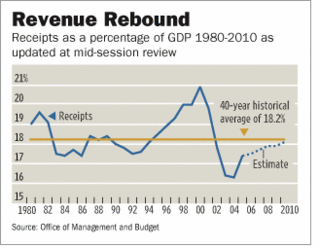 Now, as far as my eye can see, revenue receipts per this chart have been over the 40-year historical average of 18.2% in only two sustained periods: 1980-82 and 1994-2001. As readers will recall, the Reagan tax cuts first went into effect in 1981 and then again in 1986. This graph clearly shows that revenue receipts, except for minor blips in 1987 and 1989, were below the 40-year historical average not only through the "seven fat years (1983-1989)" of the Reagan presidency, but also through the three lean years (1990-92) of Bush 41. Revenue receipts then began their climb over the 40-year historical average in the "seven fat years (1994-2001)" of the Clinton presidency. After the "trifecta" of 2001—recession, Bush 43’s first tax cuts, and 9/11—hit the U.S. economy, revenue receipts plunged sharply below the 40-year historical average through the remaining three years (2002-2004) of the Bush 43 first term!
These facts are there for the naked eye to see—we have been bitten twice by the supply side bug in the past 25 years, without sustained revenue rebounds. For readers that might be interested, I have presented more empirical data on this subject in my new book, "The Bush Diaries", which is being published by iUniverse next month. Notwithstanding this year’s upward surge in revenues and OMB’s optimistic estimate through 2010, I would wait at least another couple of years before celebrating any "Windfall for Washington".
"thank heaven for the tax cuts that have helped to spur the economy that is now throwing off higher tax revenues. As the chart shows, those revenues are now rising back to their modern average as a share of GDP, just as supporters of the tax cuts predicted."Here is the wonderful chart—which exemplifies the meaning of the phrase "a picture is better than a thousand words"—that they refer to:
 Now, as far as my eye can see, revenue receipts per this chart have been over the 40-year historical average of 18.2% in only two sustained periods: 1980-82 and 1994-2001. As readers will recall, the Reagan tax cuts first went into effect in 1981 and then again in 1986. This graph clearly shows that revenue receipts, except for minor blips in 1987 and 1989, were below the 40-year historical average not only through the "seven fat years (1983-1989)" of the Reagan presidency, but also through the three lean years (1990-92) of Bush 41. Revenue receipts then began their climb over the 40-year historical average in the "seven fat years (1994-2001)" of the Clinton presidency. After the "trifecta" of 2001—recession, Bush 43’s first tax cuts, and 9/11—hit the U.S. economy, revenue receipts plunged sharply below the 40-year historical average through the remaining three years (2002-2004) of the Bush 43 first term!
These facts are there for the naked eye to see—we have been bitten twice by the supply side bug in the past 25 years, without sustained revenue rebounds. For readers that might be interested, I have presented more empirical data on this subject in my new book, "The Bush Diaries", which is being published by iUniverse next month. Notwithstanding this year’s upward surge in revenues and OMB’s optimistic estimate through 2010, I would wait at least another couple of years before celebrating any "Windfall for Washington".
Friday, July 08, 2005
London - At Sixes and Sevens
Jolly old London gave new meaning to a typical English phrase, “at sixes and sevens”, when a string of bombs went off in the heart of the city the day after it had been selected as the venue for the 2012 Olympics. Brits were truly at sixes and sevens – on the sixth, they were in seventh heaven after London trumped Paris to become the host city for the 2012 Olympics, but the very next day, on the seventh, their euphoria was abruptly deep-sixed by the bombings.
Back home newspaper editorials were spinning this tragedy in line with their respective ideologies. Thus, in my left hand, The New York Times wondered “why the wealthy nations have not done enough about the root causes of terrorism and why Al Qaeda and Osama bin Laden continue to function after almost four years of the so-called war on terrorism.” While, in my right hand, The Wall Street Journal suggested that “retreat from battling the Islamists in the Middle East would only make it easier for them to take the battle to us at home, as they did yesterday in London.”
Nevertheless, it was Tunku Varadarajan, editorial features editor of The Wall Street Journal, who nailed the British character for what it is in an apolitical tribute. In the Weekend Journal’s De Gustibus column entitled, “The Sign Says 'Take Courage' and the Brits Do”, Mr. Varadarajan wrote:
So I suspect that the sixes and sevens are not going to last for very long and our dear friends across the pond will collectively pick themselves up, dust off their jacket, stick their chest out, put their chin up, and show those damn cowards how civilized people behave. As for me, the next time I am in London, I am going to use the Underground as usual – but to the first gent that I bump into on the tube, I will proffer, “Mr. Livingstone, I presume.”
Back home newspaper editorials were spinning this tragedy in line with their respective ideologies. Thus, in my left hand, The New York Times wondered “why the wealthy nations have not done enough about the root causes of terrorism and why Al Qaeda and Osama bin Laden continue to function after almost four years of the so-called war on terrorism.” While, in my right hand, The Wall Street Journal suggested that “retreat from battling the Islamists in the Middle East would only make it easier for them to take the battle to us at home, as they did yesterday in London.”
Nevertheless, it was Tunku Varadarajan, editorial features editor of The Wall Street Journal, who nailed the British character for what it is in an apolitical tribute. In the Weekend Journal’s De Gustibus column entitled, “The Sign Says 'Take Courage' and the Brits Do”, Mr. Varadarajan wrote:
It really is considered unseemly to complain, or to feel sorry for oneself, among Britons: This aversion to self-pity is bad for the terrorists, who thrive on attention and the sowing of chaos. They won’t get much satisfaction in Britain. Londoners will not retreat into their shells, and they are unlikely to do as the Spaniards did and draw out the tragedy with a lot of public recrimination, or to capitulate in any way.
The secret of British composure is that Britons really do feel proud of their civilization. On the whole, they apologize for very little, which is as it should be. Their message to terrorists is always likely to be straight and robust: “How dare you! I'm British!”
So I suspect that the sixes and sevens are not going to last for very long and our dear friends across the pond will collectively pick themselves up, dust off their jacket, stick their chest out, put their chin up, and show those damn cowards how civilized people behave. As for me, the next time I am in London, I am going to use the Underground as usual – but to the first gent that I bump into on the tube, I will proffer, “Mr. Livingstone, I presume.”
Saturday, June 18, 2005
"The Bush Diaries" — Unmasking the President’s Performance
If you enjoy reading the posts on this blog, you are going to love the revelations in my new book entitled, “The Bush Diaries: A Citizen’s Review of the First Term”, which is due to be released later this summer. The Bush Diaries tracks the performance of President George W. Bush and attendant media pundits throughout his tumultuous first term.
In the past couple of years, I kept tabs on what the political pundits — at The Washington Post, The Wall Street Journal, and The New York Times — had to say about the President’s policies and responded to them in real time. Some of my opinions even got published by each one of these prestigious newspapers. The key difference between my book and others that you might have read on President Bush: I comment not only on the performance of the President, but I also critique the media pundits who evaluate the presidency. In fact, The Bush Diaries has a few “Great Moments in Punditry” that would make aficionados of “The Daily Show with Jon Stewart” proud. However, my only caveat being there is nothing fake about the news in my book.
The Bush Diaries is a compendium of various letters — to the editors of the aforementioned newspapers — that I wrote during the second half of Bush’s first term. Other contemporaneous articles that I had written earlier on the President’s economic and foreign policies cover the first half of his term. In developing the book, I organized my articles and letters in a chronological order and then inserted a current preface to each one of them, so that the entire narrative reads like a running commentary on the Bush presidency.
It is important to keep the Bush Administration’s “past actions” in mind (for example, their machinations prior to the Iraq War), while contemplating support for likely “future events” (e.g. dealing with the crises in Iran and North Korea). I took the liberty of offering suggestions and making recommendations on a number of economic and foreign policy issues, which I believe will impact the President’s second term.
The Bush Diaries offers a simple foreign policy message to the President — stick with those comfortable Cs in dealing with other countries, especially in the Muslim world — our foreign policy should reflect our core values, it should be applied consistently, and the President should forsake convenience by refusing to make policy exceptions for allied countries with values that are antithetical to ours.
On the domestic policy front, I recommend that the President needs to seriously work on his Ds and Es, and drop those polarizing Gs. Thus, the President has to first and foremost deal with the troublesome Ds — by reducing the massive budget and trade deficits, and by boosting the value of the dollar. He simultaneously needs to work with both parties in Congress to reach a consensus on the critical Es — education, the environment, and energy policy. Finally, the President must stop politicizing those infamous Gs — god, guns, and gays — the election is over, he won, and it’s time to show some grace!
The Bush Diaries is being published by iUniverse and will be available online at www.amazon.com just in time to round off this great summer.
In the past couple of years, I kept tabs on what the political pundits — at The Washington Post, The Wall Street Journal, and The New York Times — had to say about the President’s policies and responded to them in real time. Some of my opinions even got published by each one of these prestigious newspapers. The key difference between my book and others that you might have read on President Bush: I comment not only on the performance of the President, but I also critique the media pundits who evaluate the presidency. In fact, The Bush Diaries has a few “Great Moments in Punditry” that would make aficionados of “The Daily Show with Jon Stewart” proud. However, my only caveat being there is nothing fake about the news in my book.
The Bush Diaries is a compendium of various letters — to the editors of the aforementioned newspapers — that I wrote during the second half of Bush’s first term. Other contemporaneous articles that I had written earlier on the President’s economic and foreign policies cover the first half of his term. In developing the book, I organized my articles and letters in a chronological order and then inserted a current preface to each one of them, so that the entire narrative reads like a running commentary on the Bush presidency.
It is important to keep the Bush Administration’s “past actions” in mind (for example, their machinations prior to the Iraq War), while contemplating support for likely “future events” (e.g. dealing with the crises in Iran and North Korea). I took the liberty of offering suggestions and making recommendations on a number of economic and foreign policy issues, which I believe will impact the President’s second term.
The Bush Diaries offers a simple foreign policy message to the President — stick with those comfortable Cs in dealing with other countries, especially in the Muslim world — our foreign policy should reflect our core values, it should be applied consistently, and the President should forsake convenience by refusing to make policy exceptions for allied countries with values that are antithetical to ours.
On the domestic policy front, I recommend that the President needs to seriously work on his Ds and Es, and drop those polarizing Gs. Thus, the President has to first and foremost deal with the troublesome Ds — by reducing the massive budget and trade deficits, and by boosting the value of the dollar. He simultaneously needs to work with both parties in Congress to reach a consensus on the critical Es — education, the environment, and energy policy. Finally, the President must stop politicizing those infamous Gs — god, guns, and gays — the election is over, he won, and it’s time to show some grace!
The Bush Diaries is being published by iUniverse and will be available online at www.amazon.com just in time to round off this great summer.
Thursday, June 02, 2005
Without Mark Felt "our long national nightmare" would be still going on!
Watergate was a criminal conspiracy, exposed in large part by The Washington Post, which brought down a Republican president. Whitewater was a shady deal, conflated to some extent by the editorial pages of The Wall Street Journal, which unfairly tormented a Democratic president. So when the WSJ editorial page compares the two in “Deep Throat's Legacy”, the only commonality that I see is the “water” part. While the Watergate investigation opened the floodgates to expose real corruption, the Whitewater probe closed the dikes due to a drought of valid information. The WSJ editors conclude that “the Fourth Estate's first duty is to report the facts” — advice that they should have followed back in the 1990s when they were obsessing over Whitewater. By continuously churning Whitewater, they managed to create a lot of turbulence and no dirt really settled. Per the old adage, they should have known that “still waters run deep”.
Speaking of deep, Washington has been agog in the past couple of days with the outing of “Deep Throat” after 33 years under cover. This is a truly remarkable story in a number of ways, since it highlights:
* The irony of Woodward and Bernstein preserving a secret for three decades in a town that they seduced for gobs of information over three tumultuous years (1972-74) to unravel a corrupt presidency. Undoubtedly, along with Ben Bradlee, they have helped restore some integrity to journalism, which has taken a pounding in the past few years with the problems at The New York Times and USA Today.
* The dilemma for conservatives now vilifying W. Mark Felt, since he was pardoned by their hero, Ronald Reagan — albeit in a separate case. Nevertheless, President Reagan’s statement, while granting a pardon in 1981 to FBI agents Mark Felt and Edward Miller, praised “their good-faith belief that their actions were necessary to preserve the security interests of our country” and also said that they were “two men who acted on high principle”.
* The indispensable value of one’s conscience in prodding one to do the right thing, irrespective of one’s personal motives, as long as one determines that there are tangible benefits to organization, society, government, etc. in the long run.
Finally, one has to wonder, without Deep Throat how would “our long national nightmare” have ended? Here’s one scenario – Nixon would have completed his second term, Ford would have then probably beaten Carter in 1976, but Ford would have then lost to Mondale in 1980, Reagan would have been too old to run in 1984, so Mondale would have won a second term by beating Bush Sr. instead, Clinton would have defeated Dole in 1988 (instead of 1996), but Clinton would have lost a second term to Perot in 1992 – both, Republicans and Democrats, must agree that without W. Mark Felt "our long national nightmare" would be still going on!
Thursday, May 19, 2005
Colonial Imprints and Perceived Proselytizing in the Muslim World
The Wall Street Journal ran, what I thought was, a self-serving editorial entitled “Journalists and the Military” on May 17. In it they sanctimoniously chastised Newsweek for its explanation of what they called a “dubious Koran desecration story”. So I wrote them the following letter in response:
Now, Anne Applebaum had also made some good points on the Newsweek story in her column entitled “Blaming the Messenger” in yesterday’s Washington Post. However, she had concluded her piece with the following statement:
Why is it that conservative media outlets, such as yours, exhibit a “holier than thou” attitude when writing about the media in general? The “basic media mistrust of the military that goes back to Vietnam and has shown itself with a vengeance during the Iraq conflict and the war on terror” is a figment of your imagination. The reality is that the larger media is still smarting from being “led by the nose”, by the Bush Administration and its conservative media backers (you, again), during the build up to the Iraq war. I am inclined to believe that the larger media does not mistrust the military – it mistrusts those that led us into this war on false pretenses!Needless to say, my contrarian viewpoint was not included among the seven largely supportive (of their editorial) letters that got published in today’s edition of the Journal under the headline, “Newsweek and the Story That Never Was”. Notwithstanding their rejection, I was placated by David Brooks’ column entitled “Bashing Newsweek” in today’s New York Times. By seeing the forest for the trees, this conservative columnist offered a rational analysis of the entire incident, including the subsequent hysteria that it generated.
Now, Anne Applebaum had also made some good points on the Newsweek story in her column entitled “Blaming the Messenger” in yesterday’s Washington Post. However, she had concluded her piece with the following statement:
And, yes, people whose military and diplomatic priorities include the defeat of Islamic fanaticism and the spread of democratic values in the Muslim world need to be very, very careful, not only about what they say but about what they do to the Muslims they hold in captivity.In my mind, there is an inherent contradiction embedded in this statement and it is captured in the phrase “Islamic fanaticism”. When the western media qualifies the fanatical behavior of terrorists by associating it with the Islamic faith – that in of itself is a problem! Even if this association were true in the eyes of the western media, the war on terrorism can never be won until such a derogatory association between fanaticism and Islam is severed. If we are to win over the hearts and minds of the larger Muslim populace, the western world – which happens to be a largely Judeo-Christian world – has to “cease and desist” from linking terrorism with Islam. As long as the insurgents in Iraq are viewed as defenders of their faith by the larger Muslim populace, it will be almost impossible for us to rid Iraq of the insurgency. Similarly, Osama Bin Laden can never be captured as long as we continue to represent him as an “Islamic fundamentalist”. In fact, I have repeatedly made this point in my forthcoming book, “The Bush Diaries”, as illustrated in the sample below:
History has proven time and again that wars, which are based on religious differences, last for the longest time. Neither side is ever willing to concede that they are the “children of a lesser God”. The western world’s consistent references to “Islamic fundamentalism” only fuel the anger of the Muslim world. If the war on terrorism is ever to be won it has to be divested of its religious inferences.This might sound simplistic, but it is the truth. Newsweek happened to touch a raw nerve, which had long been exposed by the serial bungling – as characterized by Ms. Applebaum in her column – of the Bush Administration in its prosecution of the war on terrorism. If we are to win this war, the western world’s policies must be consistent – not only “walking the walk” without any colonial imprints, but also “talking the talk” without any perceived proselytizing – throughout the Muslim world.
Tuesday, April 12, 2005
Third World Power Play
When China and India “hook up”, it’s more like a third of the world in play – because the power is in their sheer numbers. John Lancaster’s report entitled “India, China Hoping to 'Reshape the World Order' Together” in today’s Washington Post makes me want to say “I told you so”. In any event, the highlights of Mr. Lancaster’s report are as follows:
[1] George Melloan writes the “Global View” column for The Wall Street Journal. This particular article entitled “Bush Wades Into Some of The World's Worst Messes” appeared in his column on June 24, 2003.
* “India-China relations have now acquired a global and strategic character” per a joint statement by the two nationsWell, nearly two years ago, in response to a George Melloan article[1], I had written a letter to The Wall Street Journal on June 24, 2003. Although it was never published, I would like to reproduce the following excerpt from that letter, which I have also included in my book, “The Bush Diaries”:
* China also announced its support for India's bid for a permanent seat on the U.N. Security Council
* China and India signed agreements on trade, economic cooperation, technology sharing, civil aviation and other matters
* India and China pledged to boost their trade to $20 billion by 2008 (the same level as US-India trade in 2004)
Coincidentally, only a day earlier, the leader of the world’s most populous country, Prime Minister Wen Jiabao of China welcomed the leader of the world’s largest democracy, Prime Minister Vajpayee of India. If President Bush were following a truly principled foreign policy, which actually saw the forest for the trees, he would recognize that our long-term interests are not being served by sacrificing our democratic ideals at the expense of our security needs? Pushing India, a close ally of Russia, into the arms of China – creates a triumvirate with far-reaching influence across the globe! How long before Germany and France jump on that bandwagon?Then in January of this year, I made this further observation in my yet to be published “The Bush Diaries”:
But I see two headstrong democracies, the oldest and the largest, butting heads over foreign policy differences, much along the lines that I have written throughout this book. Now that India’s economy has opened up, I can see the United States and India getting closer as economic partners – in the long run, probably developing stronger economic ties than we have with China? Whether we can make India a true political and military ally anytime soon is highly doubtful? Our post-9/11 tilt towards Pakistan, despite its links to the Taliban government in Afghanistan, did not sit well with the larger Indian population. Also, the recent rewarding of “major non-NATO ally” status to Pakistan, while Osama Bin Laden is still on the loose inside Pakistan, was a slap in the face to India. If the U.S. pushes for making India a permanent member of the Security Council, as it should be, then “Old Europe could make some headway for New Delhi”. Although I do believe that we do not need to sacrifice Old Europe, in order to make new friends. Nevertheless, it is a strategic imperative for the United States to quickly re-align itself to the new realities in the Asia-Pacific region.When Thom Shanker and Joel Brinkley's report entitled, "U.S. Is Set to Sell Jets to Pakistan; India Is Critical" appeared recently in The New York Times, I notched up another unpublished letter (dated March 26, 2005) that provided this blunt admonition:
In the post-Cold War era, U.S. foreign policy can no longer be based on equating its traditional ally, Pakistan, with India. This is tantamount to equating Taiwan with China - which continues to be under a Western nations arms embargo that the Bush Administration is pressuring the European Union from lifting. The overall effect of this Bush policy is going to bring, not only China and India closer, but also rekindle Russia as a potential arms supplier to both nations. From an economic standpoint, OPEC countries such as Iran and Venezuela have already announced as key suppliers of their energy needs. It isn't unrealistic to expect a new Shiite power (Iran-Iraq) to emerge as a counter to the reigning Sunni (Saudi Arabia-Kuwait-U.A.E) sway in OPEC.In the light of today’s Post report, this power play - by two nations that represent a third of humanity - is the first big move towards aforementioned structural realignment. I trust that the foreign policy visionaries in the Bush Administration are looking beyond “freedom and democracy” in the Middle East. For there is a political tsunami brewing further east and it has the potential to wash up far beyond its shores!
As the new triumvirate of China-India-Russia becomes increasingly powerful, its influence will start drawing other nations such as Afghanistan, Brazil, Canada, France, Germany, Indonesia, Malaysia, and eventually the new Iraq further away from the U.S. fold. If we do not play our foreign policy cards right, we could witness a structural realignment in the next decade, whose impact on the western world could be worse than that of the Cold War. To be forewarned is to be forearmed.
[1] George Melloan writes the “Global View” column for The Wall Street Journal. This particular article entitled “Bush Wades Into Some of The World's Worst Messes” appeared in his column on June 24, 2003.
Tuesday, April 05, 2005
Jack Nargundkar vs. James Taranto in “Best of the Web Today”
Who would have thought that my letter published in The New York Times on Friday, April 1, 2005 would create such a buzz? The letter pointed out several lessons learned from the Terri Schiavo case. But this one point in the letter seemed to have especially galled conservatives:
So James Taranto, Editor of the OpinionJournal, offered me some help in his “Best of the Web Today” column yesterday. In offering me that unsolicited advice, I felt that Mr. Taranto had missed the crux of my argument. I therefore e-mailed him a clarification this morning. Sure enough, Mr. Taranto published only the first part of my response in his column today. Here’s the second part, which he did not publish, and which is critical to my line of reasoning:
In drawing “attention to sloppy thinking” in today's column, Mr. Taranto makes a conclusion, which I never did:
The most critical conclusion to be drawn from the [Schiavo] case is that with the injection of religion into our politics and our governance, it has become increasingly difficult to differentiate between the demands of "evangelism" in a Western democracy and "fundamentalism" in a Middle Eastern theocracy.
So James Taranto, Editor of the OpinionJournal, offered me some help in his “Best of the Web Today” column yesterday. In offering me that unsolicited advice, I felt that Mr. Taranto had missed the crux of my argument. I therefore e-mailed him a clarification this morning. Sure enough, Mr. Taranto published only the first part of my response in his column today. Here’s the second part, which he did not publish, and which is critical to my line of reasoning:
James, in my letter to the The New York Times, I had also said, "If we really want to promote a 'culture of life', then human life ought to be precious in every situation, and not only under political circumstances." Politicians (Congress and the President) tried to force the courts to act in a certain way (i.e., reinsert Terri Schiavo's feeding tube, in order to save her life). The courts, per their interpretation of the law, consistently refused to act in the way intended by these politicians. If we are to convince other nations, including fledgling democracies and Middle Eastern theocracies that we are a nation of laws, albeit, secular laws - then, evangelists in this country need to accept that fact as gospel! With your distinguishing remark, "If someone is demanding that a life be spared, he's probably an evangelist in a Western democracy. If he's demanding the infidels be murdered, chances are he's a fundamentalist in a Middle Eastern theocracy", you confirm my other observation in my letter to the Times - conservatives have let emotions override their better judgment on this issue!
In drawing “attention to sloppy thinking” in today's column, Mr. Taranto makes a conclusion, which I never did:
“But equating them to fundamentalist terrorists is a cheap shot, and an intellectually indefensible one.”I never inferred that evangelical Christians, trying to save the life of a woman on life support, were the equivalent of fundamentalist terrorists. My larger point was simply this - if we let our religious beliefs dictate against the established law of the land, we are not only violating our constitution but also allowing ourselves to become like them. Mr. Taranto's refers to Martin Luther King as one:
"who made no effort to separate his belief in racial equality from its roots in Christianity".But Mr. King equally drew from "The Declaration of Independence" in demanding this equality:
"We hold these truths to be self-evident, that all men are created equal, that they are endowed by their Creator with certain unalienable Rights, that among these are Life, Liberty and the pursuit of Happiness."It is OK to use one’s faith as a personal guide to govern, but it is unconstitutional to use one’s religion as an instrument of government – that’s what theocracies do. By honoring the principle of “separation of powers”, we should all want them to become more like us - that was my key message in my letter to the Times!
Subscribe to:
Posts (Atom)